---
description: "Carbon Sequestration Vs Carbon Capture: While the former prevents carbon release post-combustion, the latter extracts & stores it."
title: "Carbon Sequestration Vs Carbon Capture: What's the Difference? - Energy Theory"
image: https://energytheory.com/wp-content/uploads/2024/02/carbon-sequestration-vs-carbon-capture.png
---
Close Menu
- [About](https://energytheory.com/about-us/)
- [EV](https://energytheory.com/category/electric-vehicles/)
- [FAQs](https://energytheory.com/category/faqs/)
- [Glossary](https://energytheory.com/category/glossary/)
- [Green](https://energytheory.com/category/green/)
- [Renewable](https://energytheory.com/category/renewable/)
- [Sustainable](https://energytheory.com/category/sustainable/)
- [Energy Economy](https://energytheory.com/category/energy-economy/)
- [Energy Services](https://energytheory.com/category/energy-services/)
- [Solar](https://energytheory.com/category/solar/)
- [Sustainable](https://energytheory.com/category/sustainable/)
- [News](https://energytheory.com/category/latest-news/)
- Language
[](https://energytheory.com/ "Energy Theory")
 English
 Spanish  French  English  Italian  Chinese (Simplified)  Dutch  Finnish  German  Hindi  Japanese  Polish  Portuguese  Russian
[](https://energytheory.com/ "Energy Theory")
 English
 Spanish  French  English  Italian  Chinese (Simplified)  Dutch  Finnish  German  Hindi  Japanese  Polish  Portuguese  Russian
[Climate Change](https://energytheory.com/category/climate-change/)
# Carbon Sequestration Vs Carbon Capture: What’s the Difference?
Capturing carbon prevents emissions from entering the air while sequestering it stores atmospheric carbon dioxide.
By [Olivia Bolt](https://energytheory.com/author/olivia_bolt/)March 27, 20243 Mins Read
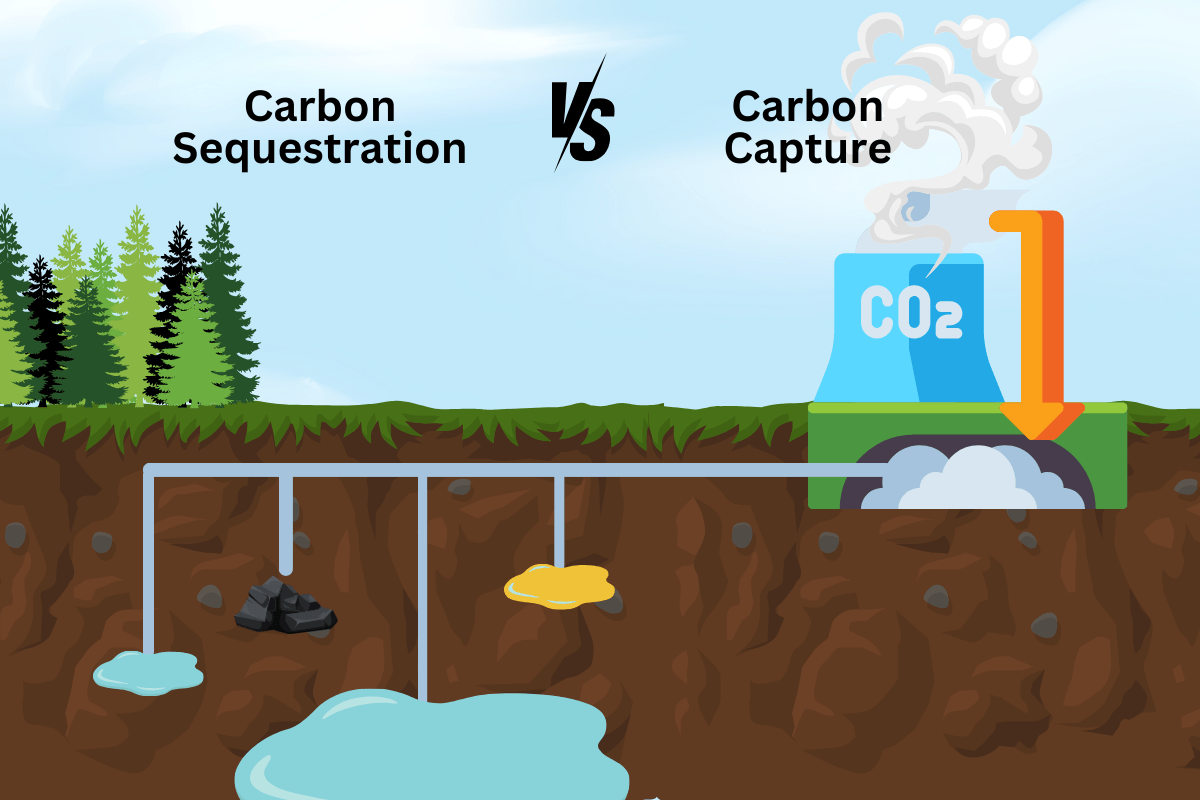
These carbon-trapping strategies are important for reducing climate change and promoting a sustainable environment. However, carbon sequestration and carbon capture offer different methods. Come let us compare their process to help you understand better.
## **Carbon Sequestration Vs Carbon Capture**
While the carbon sequestration process prevents carbon release post-combustion, carbon capture method extracts and stores it. Did you know carbon capture, utilization and sequestration (CCUS) can capture approximately [0.1% of global emissions](https://www.wri.org/insights/carbon-capture-technology) or 45 million metric tons of CO2?
Below you can explore the difference between carbon sequestration and carbon capture:
| **Parameters** | **Carbon Capture** | **Carbon Sequestration** |
| --- | --- | --- |
| **Emission Reduction** | Captures carbon after combustion which prevents its release into the atmosphere. | Extracts carbon from the atmosphere and then storing it in natural reservoirs. |
| **Methods** | Pre/Post-combustion carbon capture and oxy-fuel combustion systems. | Biological sequestration and geological sequestration systems. |
| **Overall Effectiveness** | Costly and has limited global incentives. | Establishing and maintaining carbon sinks is costly and complex. This affects its global efficiency. |
### **How does Carbon Capture Work? **

It works to **prevent carbon emissions from entering the atmosphere** by reusing or storing them underground. The methods range from small-scale tree planting to large-scale techniques such as post-combustion capture and direct air capture.
- Post-combustion capture collects emissions from a variety of sources such as power plants or industrial locations and recovers CO2 using chemicals.
- On the other hand, direct air capture takes CO2 directly from the air but it is expensive and energy-intensive.
Once captured, separated carbon dioxide is compressed for pipeline transportation. After that, it is used for commercial purposes like carbonating beverages and improving crude oil extraction.
**Also See:** [Boomitra’s Clean-Tech Carbon Capture Approach for Farmers](https://energytheory.com/boomitras-clean-tech-carbon-capture-approach-for-farmers/)
### **How does Carbon Sequestration Work? **
It works by **capturing, removing, and storage of carbon dioxide (CO2)** from the atmosphere which is an important approach for reducing its levels.
This process is one of the ways how is carbon removed from the atmosphere while preventing further emissions. It occurs biologically or geologically and is promoted both artificially and naturally on an enormous scale in the environment.
However, this method offers advantages and disadvantages if you are keen to know check out [what is carbon sequestration.](https://energytheory.com/what-is-carbon-sequestration/)
### **Carbon Capture Vs Carbon Removal**

They are often used interchangeably but it differs. If we look at the cost analysis, they both are expensive setups and may require some policy support too.
| **Parameters** | **Carbon Capture** | **Carbon Removal** |
| --- | --- | --- |
| **Definition** | It collects CO2 from industrial emissions and then stores it underground. | It eliminates carbon from the atmosphere. |
| **Processes** | Post-Combustion Capture, Direct Air Capture, Transportation and Storage, Utilization and Sequestration. | Reforestation/Afforestation, Soil carbon sequestration, Biochar, Bioenergy, Enhanced mineralization, Direct Air Capture. |
| **Limitations** | Temporary measure but does not eliminate CO2 emissions entirely. | Slow natural carbon elimination process and requires large amounts of energy |
| **Cost Factor** | For industrial processes, $20-90 per ton of concentrated CO2.
For power and steel plants, it is $75-120 per ton of dilute CO2. | CO2 removal can be very cheap and costs [$0 per ton](https://www.edf.org/sites/default/files/documents/carbon%20removal%20vs.%20carbon%20capture%20fact%20sheet_FINAL.pdf).
But, bioenergy with carbon capture & storage costs $30 to $400.
Direct Air Capture costs $100 to $1000 depending on the input and storage. |
Ultimately, carbon sequestration vs carbon capture follows different removal methods to help reduce emissions in the atmosphere. The former process involves extracting from the atmosphere and storing it in our natural reservoirs. On the other hand, the latter captures it after combustion while preventing its release into the atmosphere. To learn about such interesting content, keep exploring our website.
**Recommended:** [Top 7 Reasons Why Carbon Capture and Storage is a Bad Idea](https://energytheory.com/problems-with-carbon-capture-and-storage/)
Share. [Facebook](https://www.facebook.com/sharer.php?u=https%3A%2F%2Fenergytheory.com%2Fcarbon-sequestration-vs-carbon-capture%2F "Share on Facebook") [Twitter](https://twitter.com/intent/tweet?url=https%3A%2F%2Fenergytheory.com%2Fcarbon-sequestration-vs-carbon-capture%2F&text=Carbon%20Sequestration%20Vs%20Carbon%20Capture%3A%20What%27s%20the%20Difference%3F "Share on X (Twitter)") [Pinterest](https://pinterest.com/pin/create/button/?url=https%3A%2F%2Fenergytheory.com%2Fcarbon-sequestration-vs-carbon-capture%2F&media=https%3A%2F%2Fenergytheory.com%2Fwp-content%2Fuploads%2F2024%2F02%2Fcarbon-sequestration-vs-carbon-capture.webp&description=Carbon%20Sequestration%20Vs%20Carbon%20Capture%3A%20What%27s%20the%20Difference%3F "Share on Pinterest") [LinkedIn](https://www.linkedin.com/shareArticle?mini=true&url=https%3A%2F%2Fenergytheory.com%2Fcarbon-sequestration-vs-carbon-capture%2F "Share on LinkedIn") [Tumblr](https://www.tumblr.com/share/link?url=https%3A%2F%2Fenergytheory.com%2Fcarbon-sequestration-vs-carbon-capture%2F&name=Carbon%20Sequestration%20Vs%20Carbon%20Capture%3A%20What%27s%20the%20Difference%3F "Share on Tumblr") [Telegram](https://t.me/share/url?url=https%3A%2F%2Fenergytheory.com%2Fcarbon-sequestration-vs-carbon-capture%2F&title=Carbon%20Sequestration%20Vs%20Carbon%20Capture%3A%20What%27s%20the%20Difference%3F "Share on Telegram") [Email](mailto:?subject=Carbon%20Sequestration%20Vs%20Carbon%20Capture%3A%20What%27s%20the%20Difference%3F&body=https%3A%2F%2Fenergytheory.com%2Fcarbon-sequestration-vs-carbon-capture%2F "Share via Email")

[Olivia Bolt](https://energytheory.com/author/olivia_bolt/)
Olivia is committed to green energy and works to help ensure our planet's long-term habitability. She takes part in environmental conservation by recycling and avoiding single-use plastic.
#### Related Posts
[](https://energytheory.com/ultrastable-2d-dion-jacobson-perovskites-achieves-19-11-efficiency/ "Ultrastable 2D Dion-Jacobson Perovskites Achieves 19.11% Efficiency")
#### [Ultrastable 2D Dion-Jacobson Perovskites Achieves 19.11% Efficiency](https://energytheory.com/ultrastable-2d-dion-jacobson-perovskites-achieves-19-11-efficiency/)
August 13, 2024
[](https://energytheory.com/solar-panels-vs-solar-shingles-major-differences-comparisons/ "Solar Panels Vs Solar Shingles: Major Differences & Comparisons")
#### [Solar Panels Vs Solar Shingles: Major Differences & Comparisons](https://energytheory.com/solar-panels-vs-solar-shingles-major-differences-comparisons/)
August 5, 2024
[](https://energytheory.com/plastic-petrochemicals-and-climate/ "Plastic, Petrochemicals, and Climate: The Hidden Culprit")
#### [Plastic, Petrochemicals, and Climate: The Hidden Culprit](https://energytheory.com/plastic-petrochemicals-and-climate/)
June 21, 2024
Add A Comment
Leave A Reply [Cancel Reply](https://energytheory.com/carbon-sequestration-vs-carbon-capture/#respond)
Save my name, email, and website in this browser for the next time I comment.
Submit
Type above and press *Enter* to search. Press *Esc* to cancel.
```json
{"@context":"https:\/\/schema.org","@graph":[{"@type":"Article","@id":"https:\/\/energytheory.com\/carbon-sequestration-vs-carbon-capture\/#article","isPartOf":{"@id":"https:\/\/energytheory.com\/carbon-sequestration-vs-carbon-capture\/"},"author":{"name":"Olivia Bolt","@id":"https:\/\/energytheory.com\/#\/schema\/person\/b13704b48c0839ab40218296652c13b8"},"headline":"Carbon Sequestration Vs Carbon Capture: What’s the Difference?","datePublished":"2024-02-14T18:08:17+00:00","dateModified":"2024-03-27T11:15:25+00:00","mainEntityOfPage":{"@id":"https:\/\/energytheory.com\/carbon-sequestration-vs-carbon-capture\/"},"wordCount":599,"commentCount":0,"publisher":{"@id":"https:\/\/energytheory.com\/#organization"},"image":{"@id":"https:\/\/energytheory.com\/carbon-sequestration-vs-carbon-capture\/#primaryimage"},"thumbnailUrl":"https:\/\/energytheory.com\/wp-content\/uploads\/2024\/02\/carbon-sequestration-vs-carbon-capture.webp","keywords":["Carbon Capture vs Carbon Removal","carbon sequestration vs carbon capture","difference between carbon sequestration and carbon capture"],"articleSection":["Climate Change","Reviews & Comparison"],"inLanguage":"en-US","potentialAction":[{"@type":"CommentAction","name":"Comment","target":["https:\/\/energytheory.com\/carbon-sequestration-vs-carbon-capture\/#respond"]}]},{"@type":"WebPage","@id":"https:\/\/energytheory.com\/carbon-sequestration-vs-carbon-capture\/","url":"https:\/\/energytheory.com\/carbon-sequestration-vs-carbon-capture\/","name":"Carbon Sequestration Vs Carbon Capture: What's the Difference? - Energy Theory","isPartOf":{"@id":"https:\/\/energytheory.com\/#website"},"primaryImageOfPage":{"@id":"https:\/\/energytheory.com\/carbon-sequestration-vs-carbon-capture\/#primaryimage"},"image":{"@id":"https:\/\/energytheory.com\/carbon-sequestration-vs-carbon-capture\/#primaryimage"},"thumbnailUrl":"https:\/\/energytheory.com\/wp-content\/uploads\/2024\/02\/carbon-sequestration-vs-carbon-capture.webp","datePublished":"2024-02-14T18:08:17+00:00","dateModified":"2024-03-27T11:15:25+00:00","description":"Carbon Sequestration Vs Carbon Capture: While the former prevents carbon release post-combustion, the latter extracts & stores it.","breadcrumb":{"@id":"https:\/\/energytheory.com\/carbon-sequestration-vs-carbon-capture\/#breadcrumb"},"inLanguage":"en-US","potentialAction":[{"@type":"ReadAction","target":["https:\/\/energytheory.com\/carbon-sequestration-vs-carbon-capture\/"]}]},{"@type":"ImageObject","inLanguage":"en-US","@id":"https:\/\/energytheory.com\/carbon-sequestration-vs-carbon-capture\/#primaryimage","url":"https:\/\/energytheory.com\/wp-content\/uploads\/2024\/02\/carbon-sequestration-vs-carbon-capture.webp","contentUrl":"https:\/\/energytheory.com\/wp-content\/uploads\/2024\/02\/carbon-sequestration-vs-carbon-capture.webp","width":1200,"height":800,"caption":"carbon sequestration vs carbon capture"},{"@type":"BreadcrumbList","@id":"https:\/\/energytheory.com\/carbon-sequestration-vs-carbon-capture\/#breadcrumb","itemListElement":[{"@type":"ListItem","position":1,"name":"Home","item":"https:\/\/energytheory.com\/"},{"@type":"ListItem","position":2,"name":"Climate Change","item":"https:\/\/energytheory.com\/category\/climate-change\/"},{"@type":"ListItem","position":3,"name":"Carbon Sequestration Vs Carbon Capture: What’s the Difference?"}]},{"@type":"WebSite","@id":"https:\/\/energytheory.com\/#website","url":"https:\/\/energytheory.com\/","name":"Energy Theory","description":"Conserve energy to preserve future","publisher":{"@id":"https:\/\/energytheory.com\/#organization"},"potentialAction":[{"@type":"SearchAction","target":{"@type":"EntryPoint","urlTemplate":"https:\/\/energytheory.com\/?s={search_term_string}"},"query-input":{"@type":"PropertyValueSpecification","valueRequired":true,"valueName":"search_term_string"}}],"inLanguage":"en-US"},{"@type":"Organization","@id":"https:\/\/energytheory.com\/#organization","name":"Energy Theory","url":"https:\/\/energytheory.com\/","logo":{"@type":"ImageObject","inLanguage":"en-US","@id":"https:\/\/energytheory.com\/#\/schema\/logo\/image\/","url":"https:\/\/energytheory.com\/wp-content\/uploads\/2022\/11\/2e3rtgthghnm.png","contentUrl":"https:\/\/energytheory.com\/wp-content\/uploads\/2022\/11\/2e3rtgthghnm.png","width":625,"height":57,"caption":"Energy Theory"},"image":{"@id":"https:\/\/energytheory.com\/#\/schema\/logo\/image\/"},"sameAs":["https:\/\/www.facebook.com\/energytheoryco"]},{"@type":"Person","@id":"https:\/\/energytheory.com\/#\/schema\/person\/b13704b48c0839ab40218296652c13b8","name":"Olivia Bolt","image":{"@type":"ImageObject","inLanguage":"en-US","@id":"https:\/\/secure.gravatar.com\/avatar\/e44b6048cc46ab5ff090bb0f7eab60cc3364aba06f873623f727e8a9215b302a?s=96&d=mm&r=g","url":"https:\/\/secure.gravatar.com\/avatar\/e44b6048cc46ab5ff090bb0f7eab60cc3364aba06f873623f727e8a9215b302a?s=96&d=mm&r=g","contentUrl":"https:\/\/secure.gravatar.com\/avatar\/e44b6048cc46ab5ff090bb0f7eab60cc3364aba06f873623f727e8a9215b302a?s=96&d=mm&r=g","caption":"Olivia Bolt"},"description":"Olivia is committed to green energy and works to help ensure our planet's long-term habitability. She takes part in environmental conservation by recycling and avoiding single-use plastic.","url":"https:\/\/energytheory.com\/author\/olivia_bolt\/"}]}
```