---
description: The plastic recycling process involves various steps such as collection, sorting, washing, shredding/grinding, and extrusion.
title: How is Plastic Recycled: Complete Plastics Recycling Process - Energy Theory
image: https://energytheory.com/wp-content/uploads/2024/01/How-is-Plastic-Recycled-Complete-Plastic-Recycling-Process-Step-by-step-guide.png
---

<!DOCTYPE html> 

[ Close Menu ](#) 

* [About](https://energytheory.com/about-us/)
* [EV](https://energytheory.com/category/electric-vehicles/)
* [FAQs](https://energytheory.com/category/faqs/)
* [Glossary](https://energytheory.com/category/glossary/)
* [Green](https://energytheory.com/category/green/)  
  * [Renewable](https://energytheory.com/category/renewable/)
  * [Sustainable](https://energytheory.com/category/sustainable/)
* [Energy Economy](https://energytheory.com/category/energy-economy/)
* [Energy Services](https://energytheory.com/category/energy-services/)
* [Solar](https://energytheory.com/category/solar/)
* [Sustainable](https://energytheory.com/category/sustainable/)
* [News](https://energytheory.com/category/latest-news/)
* [Language](#)

[ ![Energy Theory](https://energytheory.com/wp-content/uploads/2022/11/2e3rtgthghnm.png) ](https://energytheory.com/ "Energy Theory") 

![en](https://cdn.gtranslate.net/flags/svg/en.svg)English 

[![es](https://cdn.gtranslate.net/flags/svg/es.svg) Spanish](#) [![fr](https://cdn.gtranslate.net/flags/svg/fr.svg) French](#) [![en](https://cdn.gtranslate.net/flags/svg/en.svg) English](#) [![it](https://cdn.gtranslate.net/flags/svg/it.svg) Italian](#) [![zh-CN](https://cdn.gtranslate.net/flags/svg/zh-CN.svg) Chinese (Simplified)](#) [![nl](https://cdn.gtranslate.net/flags/svg/nl.svg) Dutch](#) [![fi](https://cdn.gtranslate.net/flags/svg/fi.svg) Finnish](#) [![de](https://cdn.gtranslate.net/flags/svg/de.svg) German](#) [![hi](https://cdn.gtranslate.net/flags/svg/hi.svg) Hindi](#) [![ja](https://cdn.gtranslate.net/flags/svg/ja.svg) Japanese](#) [![pl](https://cdn.gtranslate.net/flags/svg/pl.svg) Polish](#) [![pt](https://cdn.gtranslate.net/flags/svg/pt.svg) Portuguese](#) [![ru](https://cdn.gtranslate.net/flags/svg/ru.svg) Russian](#) 

[ ![Energy Theory](https://energytheory.com/wp-content/uploads/2022/11/2e3rtgthghnm.png) ](https://energytheory.com/ "Energy Theory") 

![en](https://cdn.gtranslate.net/flags/svg/en.svg)English 

[![es](https://cdn.gtranslate.net/flags/svg/es.svg) Spanish](#) [![fr](https://cdn.gtranslate.net/flags/svg/fr.svg) French](#) [![en](https://cdn.gtranslate.net/flags/svg/en.svg) English](#) [![it](https://cdn.gtranslate.net/flags/svg/it.svg) Italian](#) [![zh-CN](https://cdn.gtranslate.net/flags/svg/zh-CN.svg) Chinese (Simplified)](#) [![nl](https://cdn.gtranslate.net/flags/svg/nl.svg) Dutch](#) [![fi](https://cdn.gtranslate.net/flags/svg/fi.svg) Finnish](#) [![de](https://cdn.gtranslate.net/flags/svg/de.svg) German](#) [![hi](https://cdn.gtranslate.net/flags/svg/hi.svg) Hindi](#) [![ja](https://cdn.gtranslate.net/flags/svg/ja.svg) Japanese](#) [![pl](https://cdn.gtranslate.net/flags/svg/pl.svg) Polish](#) [![pt](https://cdn.gtranslate.net/flags/svg/pt.svg) Portuguese](#) [![ru](https://cdn.gtranslate.net/flags/svg/ru.svg) Russian](#) 

[Tips & Tricks](https://energytheory.com/category/tips-tricks/) 

# How is Plastic Recycled: Complete Plastics Recycling Process

It starts by collecting plastic waste and ends by melting and forming new pellets.

By [Olivia Bolt](https://energytheory.com/author/olivia%5Fbolt/)April 1, 20245 Mins Read

![How is Plastic Recycled Complete Plastic Recycling Process Step-by-step guide](https://energytheory.com/wp-content/uploads/2024/01/How-is-Plastic-Recycled-Complete-Plastic-Recycling-Process-Step-by-step-guide-1024x683.webp "How is Plastic Recycled: Complete Plastics Recycling Process")

It’s quite fascinating that the world has known plastic for only a little over a century, yet it has become part of almost every sphere of our lives. Also, around [400 million tons](https://www.unep.org/interactives/beat-plastic-pollution/) of plastic waste is produced every year. But do you know what happens once it reaches the recycling bin? There are various steps involved in transforming it into new products. And, in this blog, we’ll explore the detailed plastic recycling process.

## ****Plastic Recycling Process**

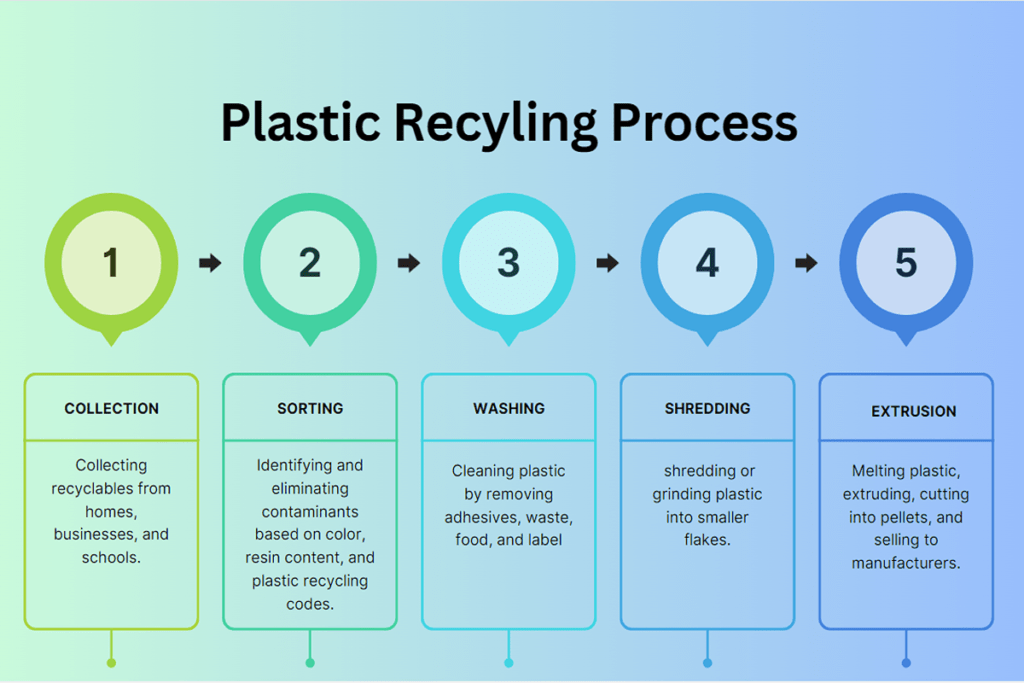
This process involves **sorting and shredding photochemical materials** to create useful products. Now, let us look at the plastic recycling flow chart.

![Plastic Recycling Process Flow Chart](https://energytheory.com/wp-content/uploads/2024/01/plastic-recycling-process-flow-chart-1024x683.webp)

It not only minimizes pollution but also prevents plastics from becoming waste. Proper recycling allows us to reuse its waste in future products. This benefits the environment, ecosystems, and human life. This explains what is plastic recycling.

### **Step 1: Collection**

It involves collecting recyclables from homes, schools, and businesses. They take the recyclables to [Material Recovery Facilities (MRF)](https://www.hse.gov.uk/waste/mrf.htm) or Plastic Recovery Facilities (PRF) for sorting. Before transportation, the material may be bulked at a waste transfer station.

It’s crucial for everyone to correctly sort their plastic for collection. The collection is **handled by local authorities or waste management contractors.** 

**Also See:** [Examples of Wet Waste and Dry Waste](https://energytheory.com/examples-of-wet-waste-and-dry-waste/)

### **Step 2: Sorting**

![sorting plastic waste](https://energytheory.com/wp-content/uploads/2024/01/sorting-plastic-waste-1024x682.jpg)

In this step, **plastic is sorted from other materials.** This process involves identifying and eliminating contaminants based on their color, size, resin content, thickness, type and recycling codes.

It is usually done at a Material Recovery Facility (MRF). But for further sorting of specific types of plastics, it may go onto a Plastic Recovery Facility (PRF).

It uses various techniques, some of which are discussed below:

* Manual picking of non-recyclables, large items, and evident contaminants to either send for disposal or for further processing.
* Trommels are cylindrical drums with holes that rotate, allowing finer materials to fall through.
* **OCC screening uses a rotating disc system** to separate old corrugated cardboard (OCC) from mixed recyclables.
* The **ballistic separator separates rigid waste items** (containers or bottles) and flexible items (paper and plastic wrapping), allowing finer materials and glass to fall through the mesh.
* Magnet separator removes any metal present in waste and sends it to a different storage bin.
* Eddy Currents for Non-Ferrous Metals produces a magnetic field repelling non-ferrous metals away from the magnet. This efficiently **separates them from non-metallic materials.**
* Optic Sorting Machine uses near-infrared (NIR) measurements to identify and **separate different plastic types by their light absorbencies.**
* Sink-Float Separator tank is filled with water and plastic to recycle. Plastic with less density floats while the high density ones sink.

Once sorted, the material is **then transferred to a plastic reprocessor** for the next stage.

Also check out the[ Benefits of Glass Recycling](https://energytheory.com/glass-recycling-benefits/)

### **Step 3: Washing and Cleaning**

Washing **ensures the cleaning of the material to remove residual and food waste**, labels, and adhesives from plastic. Different methods such as friction washers and rotary washers are used during washing. They are used on the basis of contamination levels. The former use heat, pressure and kinetic energy to clean. Whereas, the latter uses a caustic solution for removing oils and food residues.

### **Step 4: Shredding/Grinding**

![Shredding plastic waste_plastic recycling-process](https://energytheory.com/wp-content/uploads/2024/01/Shredding-plastic-waste_plastic-recycling-process-1024x682.jpg)

It is the most important step of recycling that **shreds or grinds plastic into smaller flakes**. The washed and sorted plastic goes into shredding machines, where it’s broken into smaller pieces using methods like Shear Shredders or Hammer Mills.

### **Step 5: Extrusion**

It is the final plastic recycling stage that includes **melting and forcing the plastic through an extruder**. It is then cut and formed into pellets that are then sent for manufacturing new products.

**Also See:** [30 Amazing Waste Management Facts and Statistics](https://energytheory.com/waste-management-facts/)

### **How to Recycle Plastic Bottles**

![how to recycle plastic bottles](https://energytheory.com/wp-content/uploads/2024/01/how-to-recycle-plastic-bottles-1024x683.jpg)

Let us find out.

* We need to **keep the caps on tightly** while recycling as loose caps result in stall production and other problems. This is why most of the bottles are sent to landfills.
* We should not crush the bottles as it makes them difficult to recognize at the facilities.
* It is **advised not to rinse the bottles**. We just need to empty them such that there is no visible liquid in them.
* We are not required to place them in bags because this mixes them with other recyclables. This in return complicates or slows the overall process.
* Before putting them in the recycling bin, we should **check their recyclability.** Glass and plastic sometimes have non-standard packing like some have only layers of plastic. As they are not completely plastic, they hinder the overall process.
* Outer plastic packaging of these bottles can not be disposed of in the recycling bin. Instead, we can get them processed in nearby stores.
* Another way of recycling is to **repurpose them.** We can make some DIY’s with them at home.

Big or small, actions and efforts are what bring change. By understanding the plastic recycling process and actively participating in it, you can help build a cleaner and sustainable future. To learn more about sustainability and similar habits, read our other blogs.

**Source:** [A Quick Overview of Plastic Recycling](https://www.plastivision.org/blog/a-quick-overview-of-plastic-recycling-its-processes/)

Share. [ Facebook ](https://www.facebook.com/sharer.php?u=https%3A%2F%2Fenergytheory.com%2Fplastic-recycling-process%2F "Share on Facebook") [ Twitter ](https://twitter.com/intent/tweet?url=https%3A%2F%2Fenergytheory.com%2Fplastic-recycling-process%2F&text=How%20is%20Plastic%20Recycled%3A%20Complete%20Plastics%20Recycling%20Process "Share on X (Twitter)") [ Pinterest ](https://pinterest.com/pin/create/button/?url=https%3A%2F%2Fenergytheory.com%2Fplastic-recycling-process%2F&media=https%3A%2F%2Fenergytheory.com%2Fwp-content%2Fuploads%2F2024%2F01%2FHow-is-Plastic-Recycled-Complete-Plastic-Recycling-Process-Step-by-step-guide.webp&description=How%20is%20Plastic%20Recycled%3A%20Complete%20Plastics%20Recycling%20Process "Share on Pinterest") [ LinkedIn ](https://www.linkedin.com/shareArticle?mini=true&url=https%3A%2F%2Fenergytheory.com%2Fplastic-recycling-process%2F "Share on LinkedIn") [ Tumblr ](https://www.tumblr.com/share/link?url=https%3A%2F%2Fenergytheory.com%2Fplastic-recycling-process%2F&name=How%20is%20Plastic%20Recycled%3A%20Complete%20Plastics%20Recycling%20Process "Share on Tumblr") [ Telegram ](https://t.me/share/url?url=https%3A%2F%2Fenergytheory.com%2Fplastic-recycling-process%2F&title=How%20is%20Plastic%20Recycled%3A%20Complete%20Plastics%20Recycling%20Process "Share on Telegram") [ Email ](mailto:?subject=How%20is%20Plastic%20Recycled%3A%20Complete%20Plastics%20Recycling%20Process&body=https%3A%2F%2Fenergytheory.com%2Fplastic-recycling-process%2F "Share via Email") 

![mm](https://energytheory.com/wp-content/uploads/2023/04/Olivia-150x150.jpg) 

[Olivia Bolt](https://energytheory.com/author/olivia%5Fbolt/) 

Olivia is committed to green energy and works to help ensure our planet's long-term habitability. She takes part in environmental conservation by recycling and avoiding single-use plastic.

#### Related Posts

[![ways to save water for kids](https://energytheory.com/wp-content/uploads/2024/05/ways-kids-can-save-water-300x200.png "Ways to Save Water for Kids: 10+ Easy Methods")](https://energytheory.com/ways-to-save-water-for-kids-10-easy-methods/ "Ways to Save Water for Kids: 10+ Easy Methods") 

#### [Ways to Save Water for Kids: 10+ Easy Methods](https://energytheory.com/ways-to-save-water-for-kids-10-easy-methods/)

May 28, 2024

[![products made from recycled plastic](https://energytheory.com/wp-content/uploads/2024/05/Innovative-amp-Useful-Everyday-Products-Made-From-Recycled-Plastic-2-300x200.png "20+ Innovative & Useful Everyday Products Made From Recycled Plastic")](https://energytheory.com/products-made-from-recycled-plastic/ "20+ Innovative & Useful Everyday Products Made From Recycled Plastic") 

#### [20+ Innovative & Useful Everyday Products Made From Recycled Plastic](https://energytheory.com/products-made-from-recycled-plastic/)

May 15, 2024

[![No Drill Solar Panels on Roof With and Without Adhesive](https://energytheory.com/wp-content/uploads/2024/05/No-Drill-Solar-Panels-on-Roof-With-and-Without-Adhesive-300x200.png "No Drill Solar Panels on Roof With and Without Adhesive")](https://energytheory.com/mounting-solar-panels-on-roof-without-drilling/ "No Drill Solar Panels on Roof With and Without Adhesive") 

#### [No Drill Solar Panels on Roof With and Without Adhesive](https://energytheory.com/mounting-solar-panels-on-roof-without-drilling/)

May 10, 2024

[Add A Comment ](#) 

Leave A Reply [Cancel Reply](https://energytheory.com/plastic-recycling-process/#respond)

Save my name, email, and website in this browser for the next time I comment. 

Submit 

Type above and press _Enter_ to search. Press _Esc_ to cancel.

```json
{"@context":"https:\/\/schema.org","@graph":[{"@type":"Article","@id":"https:\/\/energytheory.com\/plastic-recycling-process\/#article","isPartOf":{"@id":"https:\/\/energytheory.com\/plastic-recycling-process\/"},"author":{"name":"Olivia Bolt","@id":"https:\/\/energytheory.com\/#\/schema\/person\/b13704b48c0839ab40218296652c13b8"},"headline":"How is Plastic Recycled: Complete Plastics Recycling Process","datePublished":"2024-01-17T16:12:08+00:00","dateModified":"2024-04-01T12:46:47+00:00","mainEntityOfPage":{"@id":"https:\/\/energytheory.com\/plastic-recycling-process\/"},"wordCount":847,"commentCount":0,"publisher":{"@id":"https:\/\/energytheory.com\/#organization"},"image":{"@id":"https:\/\/energytheory.com\/plastic-recycling-process\/#primaryimage"},"thumbnailUrl":"https:\/\/energytheory.com\/wp-content\/uploads\/2024\/01\/How-is-Plastic-Recycled-Complete-Plastic-Recycling-Process-Step-by-step-guide.webp","keywords":["Plastic Recycled","plastic recycling process","recycle plastic bottles"],"articleSection":["Recycling","Tips &amp; Tricks"],"inLanguage":"en-US","potentialAction":[{"@type":"CommentAction","name":"Comment","target":["https:\/\/energytheory.com\/plastic-recycling-process\/#respond"]}]},{"@type":"WebPage","@id":"https:\/\/energytheory.com\/plastic-recycling-process\/","url":"https:\/\/energytheory.com\/plastic-recycling-process\/","name":"How is Plastic Recycled: Complete Plastics Recycling Process - Energy Theory","isPartOf":{"@id":"https:\/\/energytheory.com\/#website"},"primaryImageOfPage":{"@id":"https:\/\/energytheory.com\/plastic-recycling-process\/#primaryimage"},"image":{"@id":"https:\/\/energytheory.com\/plastic-recycling-process\/#primaryimage"},"thumbnailUrl":"https:\/\/energytheory.com\/wp-content\/uploads\/2024\/01\/How-is-Plastic-Recycled-Complete-Plastic-Recycling-Process-Step-by-step-guide.webp","datePublished":"2024-01-17T16:12:08+00:00","dateModified":"2024-04-01T12:46:47+00:00","description":"The plastic recycling process involves various steps such as collection, sorting, washing, shredding\/grinding, and extrusion.","breadcrumb":{"@id":"https:\/\/energytheory.com\/plastic-recycling-process\/#breadcrumb"},"inLanguage":"en-US","potentialAction":[{"@type":"ReadAction","target":["https:\/\/energytheory.com\/plastic-recycling-process\/"]}]},{"@type":"ImageObject","inLanguage":"en-US","@id":"https:\/\/energytheory.com\/plastic-recycling-process\/#primaryimage","url":"https:\/\/energytheory.com\/wp-content\/uploads\/2024\/01\/How-is-Plastic-Recycled-Complete-Plastic-Recycling-Process-Step-by-step-guide.webp","contentUrl":"https:\/\/energytheory.com\/wp-content\/uploads\/2024\/01\/How-is-Plastic-Recycled-Complete-Plastic-Recycling-Process-Step-by-step-guide.webp","width":1200,"height":800,"caption":"How is Plastic Recycled Complete Plastic Recycling Process Step-by-step guide"},{"@type":"BreadcrumbList","@id":"https:\/\/energytheory.com\/plastic-recycling-process\/#breadcrumb","itemListElement":[{"@type":"ListItem","position":1,"name":"Home","item":"https:\/\/energytheory.com\/"},{"@type":"ListItem","position":2,"name":"Tips &amp; Tricks","item":"https:\/\/energytheory.com\/category\/tips-tricks\/"},{"@type":"ListItem","position":3,"name":"How is Plastic Recycled: Complete Plastics Recycling Process"}]},{"@type":"WebSite","@id":"https:\/\/energytheory.com\/#website","url":"https:\/\/energytheory.com\/","name":"Energy Theory","description":"Conserve energy to preserve future","publisher":{"@id":"https:\/\/energytheory.com\/#organization"},"potentialAction":[{"@type":"SearchAction","target":{"@type":"EntryPoint","urlTemplate":"https:\/\/energytheory.com\/?s={search_term_string}"},"query-input":{"@type":"PropertyValueSpecification","valueRequired":true,"valueName":"search_term_string"}}],"inLanguage":"en-US"},{"@type":"Organization","@id":"https:\/\/energytheory.com\/#organization","name":"Energy Theory","url":"https:\/\/energytheory.com\/","logo":{"@type":"ImageObject","inLanguage":"en-US","@id":"https:\/\/energytheory.com\/#\/schema\/logo\/image\/","url":"https:\/\/energytheory.com\/wp-content\/uploads\/2022\/11\/2e3rtgthghnm.png","contentUrl":"https:\/\/energytheory.com\/wp-content\/uploads\/2022\/11\/2e3rtgthghnm.png","width":625,"height":57,"caption":"Energy Theory"},"image":{"@id":"https:\/\/energytheory.com\/#\/schema\/logo\/image\/"},"sameAs":["https:\/\/www.facebook.com\/energytheoryco"]},{"@type":"Person","@id":"https:\/\/energytheory.com\/#\/schema\/person\/b13704b48c0839ab40218296652c13b8","name":"Olivia Bolt","image":{"@type":"ImageObject","inLanguage":"en-US","@id":"https:\/\/secure.gravatar.com\/avatar\/e44b6048cc46ab5ff090bb0f7eab60cc3364aba06f873623f727e8a9215b302a?s=96&d=mm&r=g","url":"https:\/\/secure.gravatar.com\/avatar\/e44b6048cc46ab5ff090bb0f7eab60cc3364aba06f873623f727e8a9215b302a?s=96&d=mm&r=g","contentUrl":"https:\/\/secure.gravatar.com\/avatar\/e44b6048cc46ab5ff090bb0f7eab60cc3364aba06f873623f727e8a9215b302a?s=96&d=mm&r=g","caption":"Olivia Bolt"},"description":"Olivia is committed to green energy and works to help ensure our planet's long-term habitability. She takes part in environmental conservation by recycling and avoiding single-use plastic.","url":"https:\/\/energytheory.com\/author\/olivia_bolt\/"}]}
```