---
description: Researchers and Chemists at the University of LiÃ¨ge are experimenting with ways of recycling CO2 to create eco-friendly plastics.
title: Recycling CO2 to Create Eco-Friendly Plastics - Energy Theory
image: https://energytheory.com/wp-content/uploads/2023/11/Recycling-CO2-to-Create-Eco-Friendly-Plastics.png
---

<!DOCTYPE html> 

[ Close Menu ](#) 

* [About](https://energytheory.com/about-us/)
* [EV](https://energytheory.com/category/electric-vehicles/)
* [FAQs](https://energytheory.com/category/faqs/)
* [Glossary](https://energytheory.com/category/glossary/)
* [Green](https://energytheory.com/category/green/)  
  * [Renewable](https://energytheory.com/category/renewable/)
  * [Sustainable](https://energytheory.com/category/sustainable/)
* [Energy Economy](https://energytheory.com/category/energy-economy/)
* [Energy Services](https://energytheory.com/category/energy-services/)
* [Solar](https://energytheory.com/category/solar/)
* [Sustainable](https://energytheory.com/category/sustainable/)
* [News](https://energytheory.com/category/latest-news/)
* [Language](#)

[ ![Energy Theory](https://energytheory.com/wp-content/uploads/2022/11/2e3rtgthghnm.png) ](https://energytheory.com/ "Energy Theory") 

![en](https://cdn.gtranslate.net/flags/svg/en.svg)English 

[![es](https://cdn.gtranslate.net/flags/svg/es.svg) Spanish](#) [![fr](https://cdn.gtranslate.net/flags/svg/fr.svg) French](#) [![en](https://cdn.gtranslate.net/flags/svg/en.svg) English](#) [![it](https://cdn.gtranslate.net/flags/svg/it.svg) Italian](#) [![zh-CN](https://cdn.gtranslate.net/flags/svg/zh-CN.svg) Chinese (Simplified)](#) [![nl](https://cdn.gtranslate.net/flags/svg/nl.svg) Dutch](#) [![fi](https://cdn.gtranslate.net/flags/svg/fi.svg) Finnish](#) [![de](https://cdn.gtranslate.net/flags/svg/de.svg) German](#) [![hi](https://cdn.gtranslate.net/flags/svg/hi.svg) Hindi](#) [![ja](https://cdn.gtranslate.net/flags/svg/ja.svg) Japanese](#) [![pl](https://cdn.gtranslate.net/flags/svg/pl.svg) Polish](#) [![pt](https://cdn.gtranslate.net/flags/svg/pt.svg) Portuguese](#) [![ru](https://cdn.gtranslate.net/flags/svg/ru.svg) Russian](#) 

[ ![Energy Theory](https://energytheory.com/wp-content/uploads/2022/11/2e3rtgthghnm.png) ](https://energytheory.com/ "Energy Theory") 

![en](https://cdn.gtranslate.net/flags/svg/en.svg)English 

[![es](https://cdn.gtranslate.net/flags/svg/es.svg) Spanish](#) [![fr](https://cdn.gtranslate.net/flags/svg/fr.svg) French](#) [![en](https://cdn.gtranslate.net/flags/svg/en.svg) English](#) [![it](https://cdn.gtranslate.net/flags/svg/it.svg) Italian](#) [![zh-CN](https://cdn.gtranslate.net/flags/svg/zh-CN.svg) Chinese (Simplified)](#) [![nl](https://cdn.gtranslate.net/flags/svg/nl.svg) Dutch](#) [![fi](https://cdn.gtranslate.net/flags/svg/fi.svg) Finnish](#) [![de](https://cdn.gtranslate.net/flags/svg/de.svg) German](#) [![hi](https://cdn.gtranslate.net/flags/svg/hi.svg) Hindi](#) [![ja](https://cdn.gtranslate.net/flags/svg/ja.svg) Japanese](#) [![pl](https://cdn.gtranslate.net/flags/svg/pl.svg) Polish](#) [![pt](https://cdn.gtranslate.net/flags/svg/pt.svg) Portuguese](#) [![ru](https://cdn.gtranslate.net/flags/svg/ru.svg) Russian](#) 

[Glossary](https://energytheory.com/category/glossary/) 

# Recycling CO2 to Create Eco-Friendly Plastics

By [Elliot Clark](https://energytheory.com/author/elliot%5Fclark/)November 17, 20234 Mins Read

![Recycling CO2 to Create Eco-Friendly Plastics](https://energytheory.com/wp-content/uploads/2023/11/Recycling-CO2-to-Create-Eco-Friendly-Plastics-1024x683.webp "Recycling CO2 to Create Eco-Friendly Plastics")

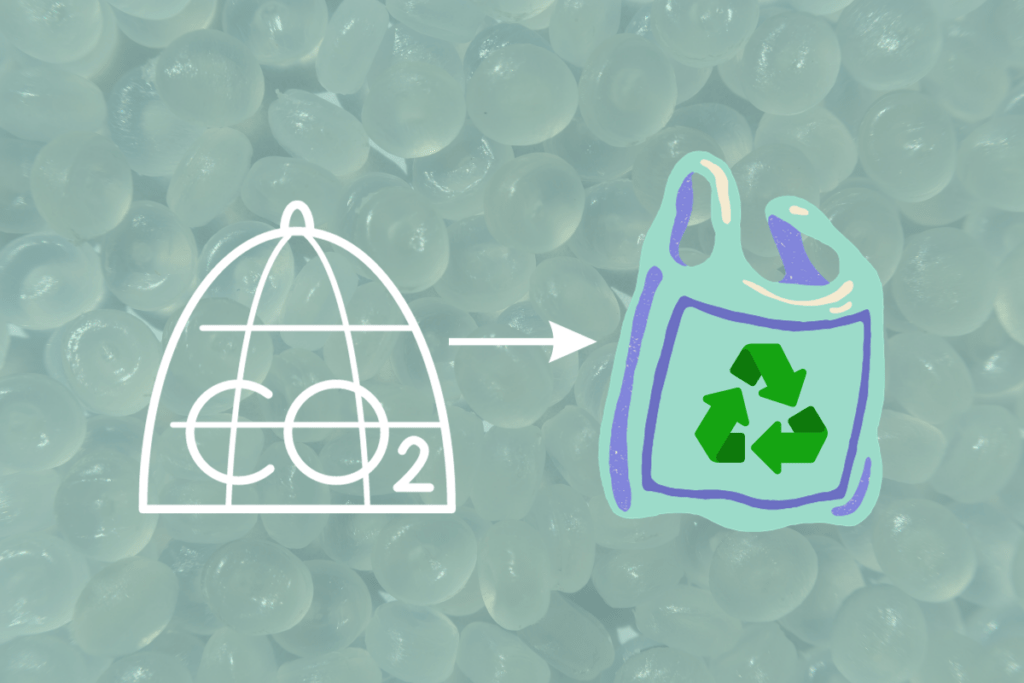
Carbon dioxide capture and storage is necessary to reduce CO2 content from the atmosphere. But recycling CO2 to create eco-friendly plastics is something new that researchers are experimenting with. A team led by chemists at the University of Li×¨ge have developed an innovative method to produce recyclable plastics using carbon dioxide (CO2).

Chemists at the University of Li×¨ge have successfully pioneered a technique in polyurethane production that utilizes CO2 to **produce innovative and highly recyclable plastics**. A new technique for producing polyurethane plastics that are easily recyclable has been reported in [a study conducted by researchers at the University of Li×¨ge](https://pubs.acs.org/doi/10.1021/jacs.3c10080), in collaboration with the University of Mons and the University of the Basque Country.

A chemist at the Center for Education and Research on Macromolecules (CERM) of the University of Li×¨ge, [Christophe Detrembleur](https://www.linkedin.com/in/christophe-detrembleur-7485b2210/?originalSubdomain=be), explains, _“This number is staggering, but not surprising, because plastics, also known as synthetic polymers, have met a large success thanks to their irreplaceable characteristics: they are light, cheap and incredibly versatile. However, the fact that they are difficult to recycle, or even impossible to recycle in the case of thermosets, has serious consequences.”_

Commodity plastics have revolutionized industries worldwide. From construction and clothing to vehicles and food packaging, these plastics have become an integral part of our everyday lives. In fact, their global usage in 2019 alone was estimated to be a staggering 460 million tons.

The inability to recycle plastics not only results in the exhaustion of fossil resources used in their production, but also in their extended presence in nature and the oceans. It is crucial for our society to swiftly develop and produce plastics that can be effortlessly recycled when they reach the end of their useful life.

A doctoral student at CERM and first author of the article, [Thomas Habets](https://scholar.google.com/citations?user=9vIIjuYAAAAJ&hl=en), explains, _“The special feature of this approach is the use of carbon dioxide (CO2)â€”a major emblematic waste of our societyâ€”as a raw material for the production of the building blocks, or monomers, needed to manufacture these new products. The structure of the monomers can be easily modified, making it possible to produce plastics with a wide range of properties, from highly malleable elastomers such as silicones to more rigid materials such as polystyrene.”_

Unlike plastics made from long molecular chains, these sustainable plastics from CO2 have **a unique chemical structure** that forms a three-dimensional network. This characteristic, typically found in difficult-to-recycle thermosets, grants them **enhanced durability and resistance**.

The polyurethanes developed from carbon dioxide recycling possess innovative dynamic chemical bonds. This implies that, despite their thermoset composition, they **can be easily reshaped** through chemical bond exchanges under mild reaction conditions.

**Also See**: [A Hopeful End to Plastic Dependency with Recyclable Polymer](https://energytheory.com/a-hopeful-end-to-plastic-dependency-with-recyclable-polymer/)

The **main benefit** of this new technology is its capability to expand the array of properties that can be accessed, all while providing numerous methods for recycling materials at their end-of-life.

Habets explains, _“These new plastics can be recycled in multiple ways, either by simply reshaping them by heating them, or by mixing different types of plastic to create hybrid materials with new properties, or by breaking them down into their constituent monomers, which is ideal for eliminating additives such as dyes or recycling composites.”_

With a focus on the future industrialization of CO2 valorization, this study **highlights the direct utilization of waste CO2** as a valuable chemical resource. Christophe Detrembleur states that, _“This is the first initial study using our new building blocks and plastics, but it is quite remarkable to see that our materials can already reach properties similar to those of some conventional Petro-sourced plastics.”_

Emerging as a potential solution, recycling CO2 to create eco-friendly plastics through this new technology possesses the **ability to develop sustainable plastics** with an extensive array of properties, effortlessly catering to the requirements of our everyday applications.

**Source**: [Toward Recyclable CO2-Based Thermosets](https://pubs.acs.org/doi/10.1021/jacs.3c10080)

Share. [ Facebook ](https://www.facebook.com/sharer.php?u=https%3A%2F%2Fenergytheory.com%2Frecycling-co2-to-create-eco-friendly-plastics%2F "Share on Facebook") [ Twitter ](https://twitter.com/intent/tweet?url=https%3A%2F%2Fenergytheory.com%2Frecycling-co2-to-create-eco-friendly-plastics%2F&text=Recycling%20CO2%20to%20Create%20Eco-Friendly%20Plastics "Share on X (Twitter)") [ Pinterest ](https://pinterest.com/pin/create/button/?url=https%3A%2F%2Fenergytheory.com%2Frecycling-co2-to-create-eco-friendly-plastics%2F&media=https%3A%2F%2Fenergytheory.com%2Fwp-content%2Fuploads%2F2023%2F11%2FRecycling-CO2-to-Create-Eco-Friendly-Plastics.webp&description=Recycling%20CO2%20to%20Create%20Eco-Friendly%20Plastics "Share on Pinterest") [ LinkedIn ](https://www.linkedin.com/shareArticle?mini=true&url=https%3A%2F%2Fenergytheory.com%2Frecycling-co2-to-create-eco-friendly-plastics%2F "Share on LinkedIn") [ Tumblr ](https://www.tumblr.com/share/link?url=https%3A%2F%2Fenergytheory.com%2Frecycling-co2-to-create-eco-friendly-plastics%2F&name=Recycling%20CO2%20to%20Create%20Eco-Friendly%20Plastics "Share on Tumblr") [ Telegram ](https://t.me/share/url?url=https%3A%2F%2Fenergytheory.com%2Frecycling-co2-to-create-eco-friendly-plastics%2F&title=Recycling%20CO2%20to%20Create%20Eco-Friendly%20Plastics "Share on Telegram") [ Email ](mailto:?subject=Recycling%20CO2%20to%20Create%20Eco-Friendly%20Plastics&body=https%3A%2F%2Fenergytheory.com%2Frecycling-co2-to-create-eco-friendly-plastics%2F "Share via Email") 

![mm](https://energytheory.com/wp-content/uploads/2023/04/Elliot1-150x150.jpg) 

[Elliot Clark](https://energytheory.com/author/elliot%5Fclark/) 

Elliot is a passionate environmentalist and blogger who has dedicated his life to spreading awareness about conservation, green energy, and renewable energy. With a background in environmental science, he has a deep understanding of the issues facing our planet and is committed to educating others on how they can make a difference.

#### Related Posts

[![Post-consumer recycled (PCR) content](https://energytheory.com/wp-content/uploads/2024/04/Post-consumer-recycled-PCR-content.png "What is Post-Consumer Recycled (PCR) Content?")](https://energytheory.com/what-is-post-consumer-recycled-pcr-content/ "What is Post-Consumer Recycled (PCR) Content?") 

#### [What is Post-Consumer Recycled (PCR) Content?](https://energytheory.com/what-is-post-consumer-recycled-pcr-content/)

April 9, 2024

[![Heating Seasonal Performance Factor (HSPF)](https://energytheory.com/wp-content/uploads/2024/02/Heating-Seasonal-Performance-Factor-HSPF.jpg "What is Heating Seasonal Performance Factor (HSPF)?")](https://energytheory.com/what-is-heating-seasonal-performance-factor-hspf/ "What is Heating Seasonal Performance Factor (HSPF)?") 

#### [What is Heating Seasonal Performance Factor (HSPF)?](https://energytheory.com/what-is-heating-seasonal-performance-factor-hspf/)

February 3, 2024

[![What is Annual Fuel Utilization Efficiency (AFUE)](https://energytheory.com/wp-content/uploads/2024/02/What-is-Annual-Fuel-Utilization-Efficiency-AFUE.jpg "What is Annual Fuel Utilization Efficiency (AFUE)?")](https://energytheory.com/what-is-annual-fuel-utilization-efficiency-afue/ "What is Annual Fuel Utilization Efficiency (AFUE)?") 

#### [What is Annual Fuel Utilization Efficiency (AFUE)?](https://energytheory.com/what-is-annual-fuel-utilization-efficiency-afue/)

February 2, 2024

[Add A Comment ](#) 

Leave A Reply [Cancel Reply](https://energytheory.com/recycling-co2-to-create-eco-friendly-plastics/#respond)

Save my name, email, and website in this browser for the next time I comment. 

Submit 

Type above and press _Enter_ to search. Press _Esc_ to cancel.

```json
{"@context":"https:\/\/schema.org","@graph":[{"@type":"Article","@id":"https:\/\/energytheory.com\/recycling-co2-to-create-eco-friendly-plastics\/#article","isPartOf":{"@id":"https:\/\/energytheory.com\/recycling-co2-to-create-eco-friendly-plastics\/"},"author":{"name":"Elliot Clark","@id":"https:\/\/energytheory.com\/#\/schema\/person\/4caf163303b45f12a7c92391d6f5f6f8"},"headline":"Recycling CO2 to Create Eco-Friendly Plastics","datePublished":"2023-11-15T11:39:19+00:00","dateModified":"2023-11-17T03:25:47+00:00","mainEntityOfPage":{"@id":"https:\/\/energytheory.com\/recycling-co2-to-create-eco-friendly-plastics\/"},"wordCount":651,"commentCount":0,"publisher":{"@id":"https:\/\/energytheory.com\/#organization"},"image":{"@id":"https:\/\/energytheory.com\/recycling-co2-to-create-eco-friendly-plastics\/#primaryimage"},"thumbnailUrl":"https:\/\/energytheory.com\/wp-content\/uploads\/2023\/11\/Recycling-CO2-to-Create-Eco-Friendly-Plastics.webp","articleSection":["Glossary"],"inLanguage":"en-US","potentialAction":[{"@type":"CommentAction","name":"Comment","target":["https:\/\/energytheory.com\/recycling-co2-to-create-eco-friendly-plastics\/#respond"]}]},{"@type":"WebPage","@id":"https:\/\/energytheory.com\/recycling-co2-to-create-eco-friendly-plastics\/","url":"https:\/\/energytheory.com\/recycling-co2-to-create-eco-friendly-plastics\/","name":"Recycling CO2 to Create Eco-Friendly Plastics - Energy Theory","isPartOf":{"@id":"https:\/\/energytheory.com\/#website"},"primaryImageOfPage":{"@id":"https:\/\/energytheory.com\/recycling-co2-to-create-eco-friendly-plastics\/#primaryimage"},"image":{"@id":"https:\/\/energytheory.com\/recycling-co2-to-create-eco-friendly-plastics\/#primaryimage"},"thumbnailUrl":"https:\/\/energytheory.com\/wp-content\/uploads\/2023\/11\/Recycling-CO2-to-Create-Eco-Friendly-Plastics.webp","datePublished":"2023-11-15T11:39:19+00:00","dateModified":"2023-11-17T03:25:47+00:00","description":"Researchers and Chemists at the University of LiÃ¨ge are experimenting with ways of recycling CO2 to create eco-friendly plastics.","breadcrumb":{"@id":"https:\/\/energytheory.com\/recycling-co2-to-create-eco-friendly-plastics\/#breadcrumb"},"inLanguage":"en-US","potentialAction":[{"@type":"ReadAction","target":["https:\/\/energytheory.com\/recycling-co2-to-create-eco-friendly-plastics\/"]}]},{"@type":"ImageObject","inLanguage":"en-US","@id":"https:\/\/energytheory.com\/recycling-co2-to-create-eco-friendly-plastics\/#primaryimage","url":"https:\/\/energytheory.com\/wp-content\/uploads\/2023\/11\/Recycling-CO2-to-Create-Eco-Friendly-Plastics.webp","contentUrl":"https:\/\/energytheory.com\/wp-content\/uploads\/2023\/11\/Recycling-CO2-to-Create-Eco-Friendly-Plastics.webp","width":1200,"height":800,"caption":"Recycling CO2 to Create Eco-Friendly Plastics"},{"@type":"BreadcrumbList","@id":"https:\/\/energytheory.com\/recycling-co2-to-create-eco-friendly-plastics\/#breadcrumb","itemListElement":[{"@type":"ListItem","position":1,"name":"Home","item":"https:\/\/energytheory.com\/"},{"@type":"ListItem","position":2,"name":"Glossary","item":"https:\/\/energytheory.com\/category\/glossary\/"},{"@type":"ListItem","position":3,"name":"Recycling CO2 to Create Eco-Friendly Plastics"}]},{"@type":"WebSite","@id":"https:\/\/energytheory.com\/#website","url":"https:\/\/energytheory.com\/","name":"Energy Theory","description":"Conserve energy to preserve future","publisher":{"@id":"https:\/\/energytheory.com\/#organization"},"potentialAction":[{"@type":"SearchAction","target":{"@type":"EntryPoint","urlTemplate":"https:\/\/energytheory.com\/?s={search_term_string}"},"query-input":{"@type":"PropertyValueSpecification","valueRequired":true,"valueName":"search_term_string"}}],"inLanguage":"en-US"},{"@type":"Organization","@id":"https:\/\/energytheory.com\/#organization","name":"Energy Theory","url":"https:\/\/energytheory.com\/","logo":{"@type":"ImageObject","inLanguage":"en-US","@id":"https:\/\/energytheory.com\/#\/schema\/logo\/image\/","url":"https:\/\/energytheory.com\/wp-content\/uploads\/2022\/11\/2e3rtgthghnm.png","contentUrl":"https:\/\/energytheory.com\/wp-content\/uploads\/2022\/11\/2e3rtgthghnm.png","width":625,"height":57,"caption":"Energy Theory"},"image":{"@id":"https:\/\/energytheory.com\/#\/schema\/logo\/image\/"},"sameAs":["https:\/\/www.facebook.com\/energytheoryco"]},{"@type":"Person","@id":"https:\/\/energytheory.com\/#\/schema\/person\/4caf163303b45f12a7c92391d6f5f6f8","name":"Elliot Clark","image":{"@type":"ImageObject","inLanguage":"en-US","@id":"https:\/\/secure.gravatar.com\/avatar\/2befe4dfd736eb7f28f89d8d8699b5945842d7bbc4a9602ced1e5bdb095c0c09?s=96&d=mm&r=g","url":"https:\/\/secure.gravatar.com\/avatar\/2befe4dfd736eb7f28f89d8d8699b5945842d7bbc4a9602ced1e5bdb095c0c09?s=96&d=mm&r=g","contentUrl":"https:\/\/secure.gravatar.com\/avatar\/2befe4dfd736eb7f28f89d8d8699b5945842d7bbc4a9602ced1e5bdb095c0c09?s=96&d=mm&r=g","caption":"Elliot Clark"},"description":"Elliot is a passionate environmentalist and blogger who has dedicated his life to spreading awareness about conservation, green energy, and renewable energy. With a background in environmental science, he has a deep understanding of the issues facing our planet and is committed to educating others on how they can make a difference.","url":"https:\/\/energytheory.com\/author\/elliot_clark\/"}]}
```