---
description: The EV tax credit calculator helps you determine the tax and cost savings when switching to an electric vehicle.
title: EV Tax Credit Calculator and Benefits in India - Energy Theory
image: https://energytheory.com/wp-content/uploads/2023/10/EV-Tax-Credit-Calculator-and-Benefits-in-India.png
---

Close Menu

- [About](https://energytheory.com/about-us/)
- [EV](https://energytheory.com/category/electric-vehicles/)
- [FAQs](https://energytheory.com/category/faqs/)
- [Glossary](https://energytheory.com/category/glossary/)
- [Green](https://energytheory.com/category/green/)
  - [Renewable](https://energytheory.com/category/renewable/)
  - [Sustainable](https://energytheory.com/category/sustainable/)
- [Energy Economy](https://energytheory.com/category/energy-economy/)
- [Energy Services](https://energytheory.com/category/energy-services/)
- [Solar](https://energytheory.com/category/solar/)
- [Sustainable](https://energytheory.com/category/sustainable/)
- [News](https://energytheory.com/category/latest-news/)
- Language

[![Energy Theory](https://energytheory.com/wp-content/uploads/2022/11/2e3rtgthghnm.png)](https://energytheory.com/ "Energy Theory")

![en](https://cdn.gtranslate.net/flags/svg/en.svg) English

![es](https://cdn.gtranslate.net/flags/svg/es.svg) Spanish ![fr](https://cdn.gtranslate.net/flags/svg/fr.svg) French ![en](https://cdn.gtranslate.net/flags/svg/en.svg) English ![it](https://cdn.gtranslate.net/flags/svg/it.svg) Italian ![zh-CN](https://cdn.gtranslate.net/flags/svg/zh-CN.svg) Chinese (Simplified) ![nl](https://cdn.gtranslate.net/flags/svg/nl.svg) Dutch ![fi](https://cdn.gtranslate.net/flags/svg/fi.svg) Finnish ![de](https://cdn.gtranslate.net/flags/svg/de.svg) German ![hi](https://cdn.gtranslate.net/flags/svg/hi.svg) Hindi ![ja](https://cdn.gtranslate.net/flags/svg/ja.svg) Japanese ![pl](https://cdn.gtranslate.net/flags/svg/pl.svg) Polish ![pt](https://cdn.gtranslate.net/flags/svg/pt.svg) Portuguese ![ru](https://cdn.gtranslate.net/flags/svg/ru.svg) Russian

[![Energy Theory](https://energytheory.com/wp-content/uploads/2022/11/2e3rtgthghnm.png)](https://energytheory.com/ "Energy Theory")

![en](https://cdn.gtranslate.net/flags/svg/en.svg) English

![es](https://cdn.gtranslate.net/flags/svg/es.svg) Spanish ![fr](https://cdn.gtranslate.net/flags/svg/fr.svg) French ![en](https://cdn.gtranslate.net/flags/svg/en.svg) English ![it](https://cdn.gtranslate.net/flags/svg/it.svg) Italian ![zh-CN](https://cdn.gtranslate.net/flags/svg/zh-CN.svg) Chinese (Simplified) ![nl](https://cdn.gtranslate.net/flags/svg/nl.svg) Dutch ![fi](https://cdn.gtranslate.net/flags/svg/fi.svg) Finnish ![de](https://cdn.gtranslate.net/flags/svg/de.svg) German ![hi](https://cdn.gtranslate.net/flags/svg/hi.svg) Hindi ![ja](https://cdn.gtranslate.net/flags/svg/ja.svg) Japanese ![pl](https://cdn.gtranslate.net/flags/svg/pl.svg) Polish ![pt](https://cdn.gtranslate.net/flags/svg/pt.svg) Portuguese ![ru](https://cdn.gtranslate.net/flags/svg/ru.svg) Russian

[Electric Vehicles](https://energytheory.com/category/electric-vehicles/)

# EV Tax Credit Calculator and Benefits in India

Discover India's efforts towards electric vehicles, supported by government incentives and tools.

By [Olivia Bolt](https://energytheory.com/author/olivia_bolt/)November 17, 20236 Mins Read

![EV Tax Credit Calculator and Benefits in India](https://energytheory.com/wp-content/uploads/2023/10/EV-Tax-Credit-Calculator-and-Benefits-in-India-1024x683.webp "EV Tax Credit Calculator and Benefits in India")

Electric vehicles (EVs) are gaining popularity in India, not only due to their environmental benefits but also because of the long-term savings. The government’s significant encouragement in the form of tax credits and deductions makes EVs an even more appealing option. You can use tools like the EV Tax Credit Calculator to see how much you can save. This article will guide you through the various electric vehicle tax benefits in India for a greener transport future.

## **EV Tax Credit Calculator and Benefits in India**

The Indian market has welcomed electric vehicles. According to reports, the market for these vehicles is set to expand. The need for alternate energy sources is a crucial factor in this expansion as people are turning to greener ways of transportation. EVs address a variety of difficulties, including exhaust pollutants, noise pollution, and so on. The electric vehicle tax benefit in India also entails **smoother driving, lower maintenance, and higher savings**.

Now, let’s talk about the e-AMRIT portal that features the EV tax credit calculator which will further help you evaluate the benefits of electric vehicles.

### **e-AMRIT Portal**

![e-AMRIT Portal](https://energytheory.com/wp-content/uploads/2023/10/e-AMRIT-Portal.webp)

*Pic Credit: Niti Aayog*

The e-AMRIT (Accelerated e-Mobility Revolution for Indian Transportation) portal, a collaboration between NITI Aayog and the United Kingdom government, aims to raise awareness about electric mobility in India. The e-AMRIT platform **features an EV calculator** that estimates the savings you could realize by switching to an electric vehicle.

It estimates the operating costs of a traditional [Internal Combustion Engine (ICE)](https://energytheory.com/what-is-internal-combustion-engine-ice/)-powered vehicle against an electric vehicle, allowing you to make an informed decision. It will help you evaluate the benefits of electric vehicles using specially built tools to calculate users’ savings with electric vehicles against petrol/diesel vehicles.

### **EV Tax Credit Calculator**

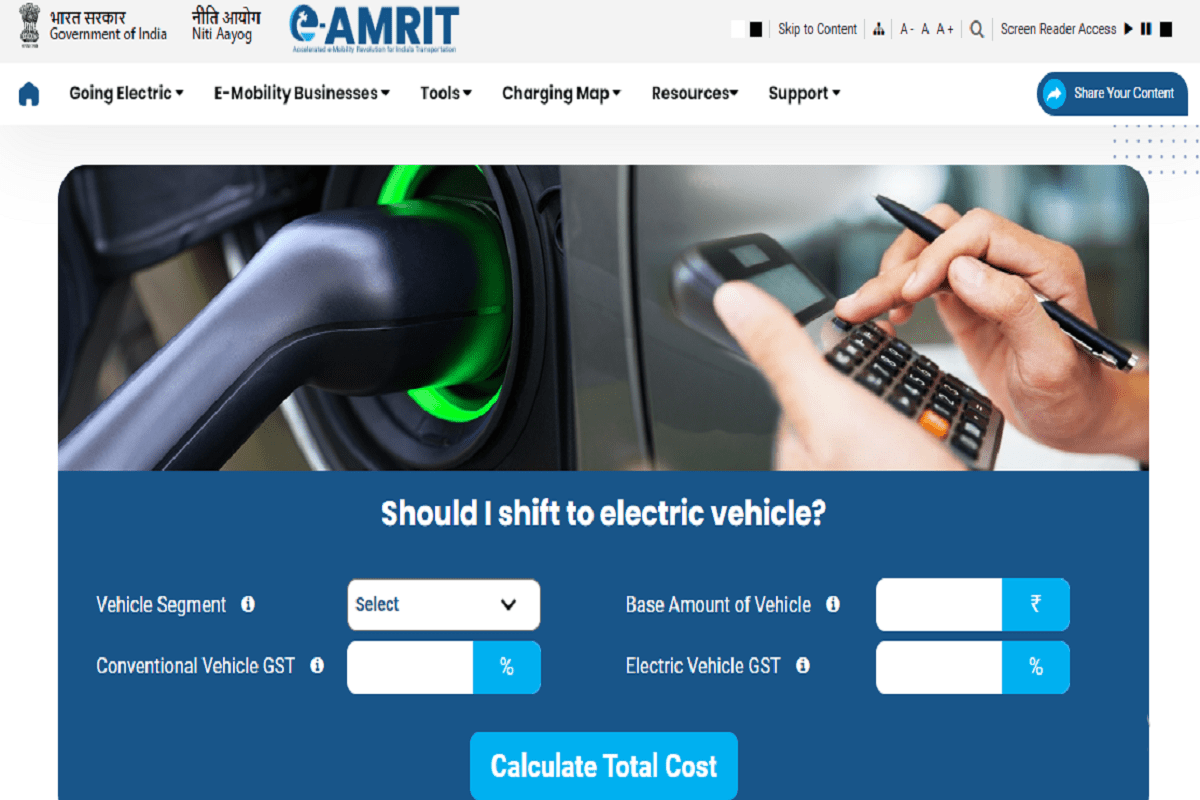
In India, the government has introduced a provision that offers tax credits for electric vehicles. The Tax Savings Calculator calculates how much tax would be avoided if a person switched from a conventional vehicle to an EV. The calculator is a simple tool that can assist you in determining whether moving to an electric vehicle (EV) is financially advantageous for you. It considers the following aspects:

- **Vehicle segment**: Two-wheeler, three-wheeler, or four-wheeler
- **Base amount of vehicle**: The ex-showroom price of the vehicle.
- **Conventional vehicle GST**: The GST rate applicable to conventional vehicles is 28%.
- **Electric vehicle GST**: The GST rate applicable to electric vehicles is 5%.

The calculator then **calculates the total cost savings**. You can also consult a financial advisor to get personalized advice on the financial benefits of switching to an EV. If you want to use the calculator, check out this [link](https://e-amrit.niti.gov.in/tax-savings-calculator).

**Also Read**: [Electric Motorcycles just became more affordable with RattanIndia’s Revolt Motors’ New Low-Cost Financing Scheme](https://energytheory.com/electric-motorcycles-just-became-more-affordable-with-rattanindias-revolt-motors-new-low-cost-financing-scheme/)

### **EV Tax Credit for Electric Vehicle Purchasers**

![Tax Credit](https://energytheory.com/wp-content/uploads/2023/10/Tax-Credit.jpg)

One notable advantage that serves as a compelling reason to invest in EVs is the electric vehicle tax benefit in India. In 2019, the government offered tax breaks under the new Section 80EEB. Individual taxpayers can **claim a tax deduction of up to 1.5 lakhs** on the interest component of a car loan used to purchase an EV under this clause.

An EV Loan can be used to buy a personal or professional electric car or bike. However, the car must be registered in the name of the owner or business. You can claim a tax deduction for the duration of the loan, that is until it is entirely repaid. Section 80EEB covers both two-wheelers and four-wheelers.

> Cross-Reference: [Budget 2023 | India may allow income tax rebate on electric vehicles for 2 more years](https://www.cnbctv18.com/personal-finance/budget-2023-income-tax-rebate-on-electric-vehicles-to-continue-for-2-more-years-15715371.htm)

### **Section 80EEB Features and Conditions**

The conditions and features for both two-wheelers and four-wheelers are:

#### **1. Amount of Deduction**

Section 80EEB allows a deduction for interest payments of up to Rs 1, 50,000. An individual taxpayer may own an electric vehicle for personal or business use. This deduction would allow persons who own an electric vehicle for personal usage to recover the interest paid on the vehicle loan.

Individuals can also** claim a deduction of up to Rs 1, 50,000** for business use under section 80EEB. Interest payments in excess of Rs 1, 50,000 can be deducted as business expenditure. You can use the EV tax credit calculator to evaluate how much tax savings you will do according to that you can create a budget.

To be claimed as a business expense, the vehicle must be registered in the name of the owner or business enterprise. Individual taxpayers should obtain an interest-paid certificate and keep all required documentation, such as tax invoices and loan paperwork, on hand when submitting their returns.

Also, take a look at our post – [The Number of EVs that can get you full Clean Vehicle Tax Credit of 7500 Dollars just went up](https://energytheory.com/the-number-of-evs-that-can-get-you-full-clean-vehicle-tax-credit-of-7500-dollars-just-went-up/)

#### **2. Section 80EEB Conditions**

Before claiming deductions under Section 80EEB, taxpayers should note the following conditions:

- The loan must have been **taken between 1 April 2019 and 31 March 2023**, and only for the purchase.
- The loan must be obtained from a bank or non-banking financial company (NBFC).
- Section 80EEB applies** only to individual taxpayers** that exclude Hindu Undivided Families (HUFS), Associations of Persons (AOPs), Limited Liability Partnerships (LIPs), businesses, or corporations.

**Note**: For the EV tax credit in 2023 and 2024, the same benefits might continue, or even better rebates may be introduced. Although there haven’t been any recent announcements about extending the scheme, don’t be discouraged. There are still incentives available to make your EV investment cost-effective and valuable.

**Also See**: [Why You Should Opt to Lease an EV Over Buying](https://energytheory.com/why-you-should-opt-to-lease-an-ev-over-buying/)

#### **Financial Incentives for Electric Vehicles**

![EV image](https://energytheory.com/wp-content/uploads/2023/10/EV-image.jpg)

A few EV-related incentives are:

**1. National Incentives**

The Indian government’s flagship initiative, **FAME** (Faster Adoption and Manufacturing of Hybrid and Electric Vehicles), aims to promote electric mobility. Currently, in its [second phase](https://fame2.heavyindustries.gov.in/) (effective from April 1st, 2019, for three years), the scheme provides the following incentives:

| **Vehicle Size** | **Approximate Battery Size** | **Approximate Total Incentives** |
| --- | --- | --- |
| **Two wheelers** | 2 kWh | Rs 15000/- per kWh (up to 40% of vehicle costs) |
| **Three wheelers** | 5 kWh | Rs 10000/- per kWh |
| **Four wheelers** | 15 kWh | Rs 10000/- per kWh |
| **E Buses** | 250 kWh | Rs 20000/- per kWh |

**2. State Incentives**

Each state has its own set of incentives for driving electric vehicles. To learn more about state-level policies, consult a financial professional for personalized guidance.

**3. Notable Incentive**

- The Union Ministry of Road Transport and Highways (MoRTH) has exempted all [battery electric vehicles](https://energytheory.com/what-are-battery-electric-vehicles-bevs/) from paying registration certificate issues and renewal fees.
- The Delhi government also declared in 2020 that under the Delhi Electric Vehicles Policy, two and four-wheeler EVs would be exempt from paying road tax.

India’s shift towards electric vehicles reflects its dedication to both environmental and smart financial choices. The EV Tax Credit Calculator and supportive policies empower citizens to make informed decisions. As the benefits of EVs become increasingly apparent to more people, India confidently steps towards a more sustainable transportation system.

**Recommended:** [How Does the Electric Car Tax Credit Work?](https://energytheory.com/how-does-the-electric-car-tax-credit-work/)

Share. [Facebook](https://www.facebook.com/sharer.php?u=https%3A%2F%2Fenergytheory.com%2Fev-tax-credit-calculator%2F "Share on Facebook") [Twitter](https://twitter.com/intent/tweet?url=https%3A%2F%2Fenergytheory.com%2Fev-tax-credit-calculator%2F&text=EV%20Tax%20Credit%20Calculator%20and%20Benefits%20in%20India "Share on X (Twitter)") [Pinterest](https://pinterest.com/pin/create/button/?url=https%3A%2F%2Fenergytheory.com%2Fev-tax-credit-calculator%2F&media=https%3A%2F%2Fenergytheory.com%2Fwp-content%2Fuploads%2F2023%2F10%2FEV-Tax-Credit-Calculator-and-Benefits-in-India.webp&description=EV%20Tax%20Credit%20Calculator%20and%20Benefits%20in%20India "Share on Pinterest") [LinkedIn](https://www.linkedin.com/shareArticle?mini=true&url=https%3A%2F%2Fenergytheory.com%2Fev-tax-credit-calculator%2F "Share on LinkedIn") [Tumblr](https://www.tumblr.com/share/link?url=https%3A%2F%2Fenergytheory.com%2Fev-tax-credit-calculator%2F&name=EV%20Tax%20Credit%20Calculator%20and%20Benefits%20in%20India "Share on Tumblr") [Telegram](https://t.me/share/url?url=https%3A%2F%2Fenergytheory.com%2Fev-tax-credit-calculator%2F&title=EV%20Tax%20Credit%20Calculator%20and%20Benefits%20in%20India "Share on Telegram") [Email](mailto:?subject=EV%20Tax%20Credit%20Calculator%20and%20Benefits%20in%20India&body=https%3A%2F%2Fenergytheory.com%2Fev-tax-credit-calculator%2F "Share via Email")

![mm](https://energytheory.com/wp-content/uploads/2023/04/Olivia-150x150.jpg)

[Olivia Bolt](https://energytheory.com/author/olivia_bolt/)

Olivia is committed to green energy and works to help ensure our planet's long-term habitability. She takes part in environmental conservation by recycling and avoiding single-use plastic.

#### Related Posts

[![Using Gen AI for Global Goals Private Sector's Guide to Sustainable Development with Technology](https://energytheory.com/wp-content/uploads/2024/09/Using-Gen-AI-for-Global-Goals-Private-Sectors-Guide-to-Sustainable-Development-with-Technology-300x200.webp "Using Gen AI for Global Goals: Private Sector’s Guide to Sustainable Development with Technology")](https://energytheory.com/using-gen-ai-for-global-goals-private-sectors-guide-to-sustainable-development-with-technology/ "Using Gen AI for Global Goals: Private Sector’s Guide to Sustainable Development with Technology")

#### [Using Gen AI for Global Goals: Private Sector’s Guide to Sustainable Development with Technology](https://energytheory.com/using-gen-ai-for-global-goals-private-sectors-guide-to-sustainable-development-with-technology/)

September 25, 2024

[![Problems and solutions in ChargerHelp's annual reliability report](https://energytheory.com/wp-content/uploads/2024/08/Annual-Reliability-Report-by-ChargerHelp-The-State-of-EV-Charging-and-the-Driver-Experience-300x200.png "Annual Reliability Report by ChargerHelp: The State of EV Charging and the Driver Experience")](https://energytheory.com/annual-reliability-report-by-chargerhelp-the-state-of-ev-charging/ "Annual Reliability Report by ChargerHelp: The State of EV Charging and the Driver Experience")

#### [Annual Reliability Report by ChargerHelp: The State of EV Charging and the Driver Experience](https://energytheory.com/annual-reliability-report-by-chargerhelp-the-state-of-ev-charging/)

August 22, 2024

[![Effects of firebricks for industrial process heat in 149 countries](https://energytheory.com/wp-content/uploads/2024/08/Effects-of-firebricks-for-industrial-process-heat-in-149-countries-300x200.png "Bronze Age Firebrick Technology Could Pave Affordable Path to Net Zero Emissions for 149 Countries")](https://energytheory.com/bronze-age-firebrick-technology-could-pave-affordable-path-to-net-zero-emissions-for-149-countries/ "Bronze Age Firebrick Technology Could Pave Affordable Path to Net Zero Emissions for 149 Countries")

#### [Bronze Age Firebrick Technology Could Pave Affordable Path to Net Zero Emissions for 149 Countries](https://energytheory.com/bronze-age-firebrick-technology-could-pave-affordable-path-to-net-zero-emissions-for-149-countries/)

August 20, 2024

Add A Comment

Leave A Reply [Cancel Reply](https://energytheory.com/ev-tax-credit-calculator/#respond)

Save my name, email, and website in this browser for the next time I comment.

Submit

Type above and press *Enter* to search. Press *Esc* to cancel.

```json
{"@context":"https:\/\/schema.org","@graph":[{"@type":"Article","@id":"https:\/\/energytheory.com\/ev-tax-credit-calculator\/#article","isPartOf":{"@id":"https:\/\/energytheory.com\/ev-tax-credit-calculator\/"},"author":{"name":"Olivia Bolt","@id":"https:\/\/energytheory.com\/#\/schema\/person\/b13704b48c0839ab40218296652c13b8"},"headline":"EV Tax Credit Calculator and Benefits in India","datePublished":"2023-10-26T15:42:19+00:00","dateModified":"2023-11-17T03:31:16+00:00","mainEntityOfPage":{"@id":"https:\/\/energytheory.com\/ev-tax-credit-calculator\/"},"wordCount":1142,"commentCount":0,"publisher":{"@id":"https:\/\/energytheory.com\/#organization"},"image":{"@id":"https:\/\/energytheory.com\/ev-tax-credit-calculator\/#primaryimage"},"thumbnailUrl":"https:\/\/energytheory.com\/wp-content\/uploads\/2023\/10\/EV-Tax-Credit-Calculator-and-Benefits-in-India.webp","keywords":["electric vehicle tax benefit India","ev tax credit calculator"],"articleSection":["Electric Vehicles","Energy Economy"],"inLanguage":"en-US","potentialAction":[{"@type":"CommentAction","name":"Comment","target":["https:\/\/energytheory.com\/ev-tax-credit-calculator\/#respond"]}]},{"@type":"WebPage","@id":"https:\/\/energytheory.com\/ev-tax-credit-calculator\/","url":"https:\/\/energytheory.com\/ev-tax-credit-calculator\/","name":"EV Tax Credit Calculator and Benefits in India - Energy Theory","isPartOf":{"@id":"https:\/\/energytheory.com\/#website"},"primaryImageOfPage":{"@id":"https:\/\/energytheory.com\/ev-tax-credit-calculator\/#primaryimage"},"image":{"@id":"https:\/\/energytheory.com\/ev-tax-credit-calculator\/#primaryimage"},"thumbnailUrl":"https:\/\/energytheory.com\/wp-content\/uploads\/2023\/10\/EV-Tax-Credit-Calculator-and-Benefits-in-India.webp","datePublished":"2023-10-26T15:42:19+00:00","dateModified":"2023-11-17T03:31:16+00:00","description":"The EV tax credit calculator helps you determine the tax and cost savings when switching to an electric vehicle.","breadcrumb":{"@id":"https:\/\/energytheory.com\/ev-tax-credit-calculator\/#breadcrumb"},"inLanguage":"en-US","potentialAction":[{"@type":"ReadAction","target":["https:\/\/energytheory.com\/ev-tax-credit-calculator\/"]}]},{"@type":"ImageObject","inLanguage":"en-US","@id":"https:\/\/energytheory.com\/ev-tax-credit-calculator\/#primaryimage","url":"https:\/\/energytheory.com\/wp-content\/uploads\/2023\/10\/EV-Tax-Credit-Calculator-and-Benefits-in-India.webp","contentUrl":"https:\/\/energytheory.com\/wp-content\/uploads\/2023\/10\/EV-Tax-Credit-Calculator-and-Benefits-in-India.webp","width":1200,"height":800,"caption":"EV Tax Credit Calculator and Benefits in India"},{"@type":"BreadcrumbList","@id":"https:\/\/energytheory.com\/ev-tax-credit-calculator\/#breadcrumb","itemListElement":[{"@type":"ListItem","position":1,"name":"Home","item":"https:\/\/energytheory.com\/"},{"@type":"ListItem","position":2,"name":"Electric Vehicles","item":"https:\/\/energytheory.com\/category\/electric-vehicles\/"},{"@type":"ListItem","position":3,"name":"EV Tax Credit Calculator and Benefits in India"}]},{"@type":"WebSite","@id":"https:\/\/energytheory.com\/#website","url":"https:\/\/energytheory.com\/","name":"Energy Theory","description":"Conserve energy to preserve future","publisher":{"@id":"https:\/\/energytheory.com\/#organization"},"potentialAction":[{"@type":"SearchAction","target":{"@type":"EntryPoint","urlTemplate":"https:\/\/energytheory.com\/?s={search_term_string}"},"query-input":{"@type":"PropertyValueSpecification","valueRequired":true,"valueName":"search_term_string"}}],"inLanguage":"en-US"},{"@type":"Organization","@id":"https:\/\/energytheory.com\/#organization","name":"Energy Theory","url":"https:\/\/energytheory.com\/","logo":{"@type":"ImageObject","inLanguage":"en-US","@id":"https:\/\/energytheory.com\/#\/schema\/logo\/image\/","url":"https:\/\/energytheory.com\/wp-content\/uploads\/2022\/11\/2e3rtgthghnm.png","contentUrl":"https:\/\/energytheory.com\/wp-content\/uploads\/2022\/11\/2e3rtgthghnm.png","width":625,"height":57,"caption":"Energy Theory"},"image":{"@id":"https:\/\/energytheory.com\/#\/schema\/logo\/image\/"},"sameAs":["https:\/\/www.facebook.com\/energytheoryco"]},{"@type":"Person","@id":"https:\/\/energytheory.com\/#\/schema\/person\/b13704b48c0839ab40218296652c13b8","name":"Olivia Bolt","image":{"@type":"ImageObject","inLanguage":"en-US","@id":"https:\/\/secure.gravatar.com\/avatar\/e44b6048cc46ab5ff090bb0f7eab60cc3364aba06f873623f727e8a9215b302a?s=96&d=mm&r=g","url":"https:\/\/secure.gravatar.com\/avatar\/e44b6048cc46ab5ff090bb0f7eab60cc3364aba06f873623f727e8a9215b302a?s=96&d=mm&r=g","contentUrl":"https:\/\/secure.gravatar.com\/avatar\/e44b6048cc46ab5ff090bb0f7eab60cc3364aba06f873623f727e8a9215b302a?s=96&d=mm&r=g","caption":"Olivia Bolt"},"description":"Olivia is committed to green energy and works to help ensure our planet's long-term habitability. She takes part in environmental conservation by recycling and avoiding single-use plastic.","url":"https:\/\/energytheory.com\/author\/olivia_bolt\/"}]}
```