---
description: "Types of Solar Tracking Systems: Single-axis Solar Trackers, Dual-axis Solar Trackers, Active Tracking Devices, and Passive Tracking Devices."
title: Types of Solar Tracking System - Energy Theory
image: https://energytheory.com/wp-content/uploads/2024/05/types-of-solar-tracing-systems.png
---

Close Menu

- [About](https://energytheory.com/about-us/)
- [EV](https://energytheory.com/category/electric-vehicles/)
- [FAQs](https://energytheory.com/category/faqs/)
- [Glossary](https://energytheory.com/category/glossary/)
- [Green](https://energytheory.com/category/green/)
  - [Renewable](https://energytheory.com/category/renewable/)
  - [Sustainable](https://energytheory.com/category/sustainable/)
- [Energy Economy](https://energytheory.com/category/energy-economy/)
- [Energy Services](https://energytheory.com/category/energy-services/)
- [Solar](https://energytheory.com/category/solar/)
- [Sustainable](https://energytheory.com/category/sustainable/)
- [News](https://energytheory.com/category/latest-news/)
- Language

[![Energy Theory](https://energytheory.com/wp-content/uploads/2022/11/2e3rtgthghnm.png)](https://energytheory.com/ "Energy Theory")

![en](https://cdn.gtranslate.net/flags/svg/en.svg) English

![es](https://cdn.gtranslate.net/flags/svg/es.svg) Spanish ![fr](https://cdn.gtranslate.net/flags/svg/fr.svg) French ![en](https://cdn.gtranslate.net/flags/svg/en.svg) English ![it](https://cdn.gtranslate.net/flags/svg/it.svg) Italian ![zh-CN](https://cdn.gtranslate.net/flags/svg/zh-CN.svg) Chinese (Simplified) ![nl](https://cdn.gtranslate.net/flags/svg/nl.svg) Dutch ![fi](https://cdn.gtranslate.net/flags/svg/fi.svg) Finnish ![de](https://cdn.gtranslate.net/flags/svg/de.svg) German ![hi](https://cdn.gtranslate.net/flags/svg/hi.svg) Hindi ![ja](https://cdn.gtranslate.net/flags/svg/ja.svg) Japanese ![pl](https://cdn.gtranslate.net/flags/svg/pl.svg) Polish ![pt](https://cdn.gtranslate.net/flags/svg/pt.svg) Portuguese ![ru](https://cdn.gtranslate.net/flags/svg/ru.svg) Russian

[![Energy Theory](https://energytheory.com/wp-content/uploads/2022/11/2e3rtgthghnm.png)](https://energytheory.com/ "Energy Theory")

![en](https://cdn.gtranslate.net/flags/svg/en.svg) English

![es](https://cdn.gtranslate.net/flags/svg/es.svg) Spanish ![fr](https://cdn.gtranslate.net/flags/svg/fr.svg) French ![en](https://cdn.gtranslate.net/flags/svg/en.svg) English ![it](https://cdn.gtranslate.net/flags/svg/it.svg) Italian ![zh-CN](https://cdn.gtranslate.net/flags/svg/zh-CN.svg) Chinese (Simplified) ![nl](https://cdn.gtranslate.net/flags/svg/nl.svg) Dutch ![fi](https://cdn.gtranslate.net/flags/svg/fi.svg) Finnish ![de](https://cdn.gtranslate.net/flags/svg/de.svg) German ![hi](https://cdn.gtranslate.net/flags/svg/hi.svg) Hindi ![ja](https://cdn.gtranslate.net/flags/svg/ja.svg) Japanese ![pl](https://cdn.gtranslate.net/flags/svg/pl.svg) Polish ![pt](https://cdn.gtranslate.net/flags/svg/pt.svg) Portuguese ![ru](https://cdn.gtranslate.net/flags/svg/ru.svg) Russian

[Solar](https://energytheory.com/category/solar/)

# Types of Solar Tracking System

These systems are used to position PV panels to directly face the sun accurately.

By [Olivia Bolt](https://energytheory.com/author/olivia_bolt/)May 9, 20248 Mins Read

![types of solar tracing system](https://energytheory.com/wp-content/uploads/2024/05/types-of-solar-tracing-systems-1024x683.png "Types of Solar Tracking System")

You might be familiar with solar panels but do you know about these trackers? Although they are less known, they are still widely used in both residential and commercial-grade solar panels due to their enhanced solar trapping technology. In this blog, we’ll primarily discuss the various types of solar tracking systems and their advantages.

## **Types of Solar Tracking System**

Before understanding the types, it’s important to know what a solar tracking system actually is. So, it is **a setup that automatically adjusts solar panels to face the sun** throughout the day. Its components include PV cells, signal processors, PLC (Programmable Logic Controller), sensors, electromagnetic and mechanical motion controls, and power supplies.

When the sunlight is strong, the sensors of this system detect this and send signals to the PLC. Then the PLC evaluates these signals and sends further instructions to the motor. The panel is then turned by the motor to face the sun directly. **When it is directly facing the sun, it generates more power** compared to when it’s not facing the sun directly. Now, let’s see the various types of solar tracking systems.

On the basis of their motion and directional flexibility, these trackers can be classified into the following types-

### **1. Single-axis Solar Trackers**

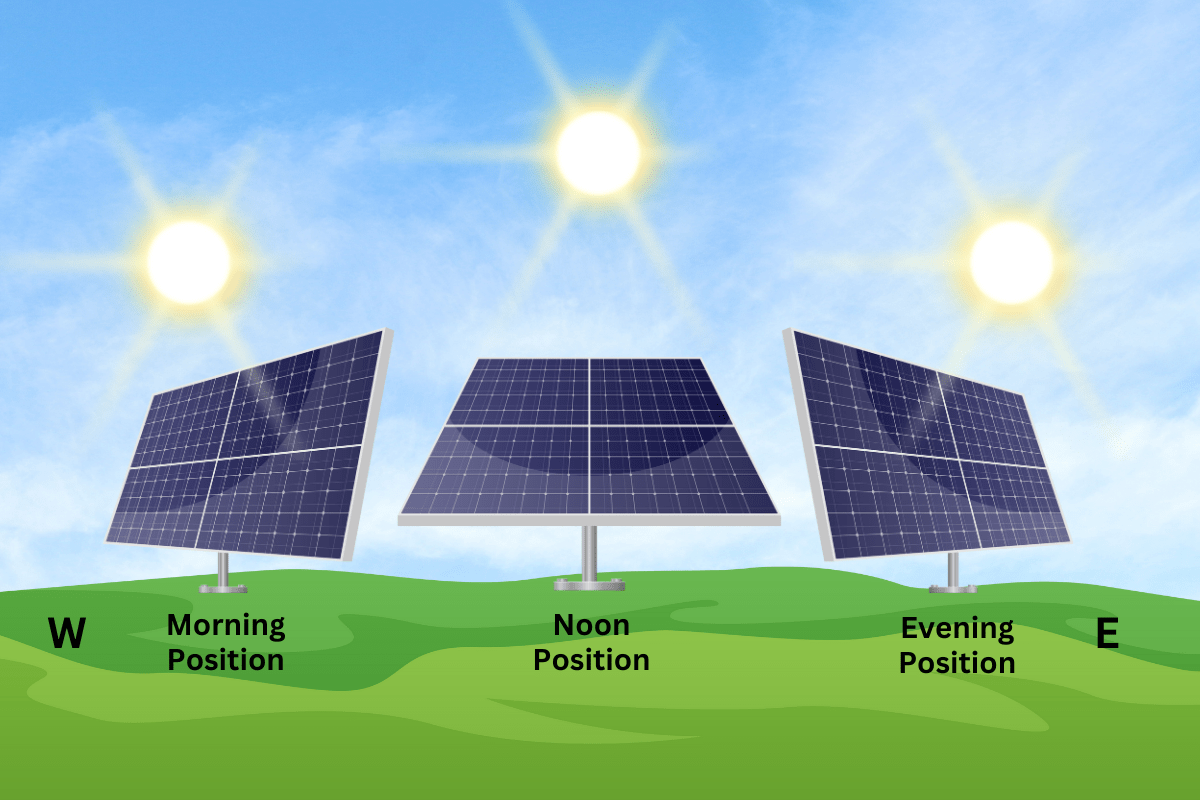
These trackers move or adjust the PV panels by** rotating them just along one axis.** It is typically facing North and South directions. This device helps the panels follow the sun from East to West as it moves throughout the day.

Using this, we can enhance the efficiency of an already existing solar system without going through the hassle of installing more solar modules. This type of tracker is great for flat areas of land that usually stay dry and sunny.

Now, let’s explore the various types of single-axis trackers such as vertical, horizontal, tilted, and polar aligned.

**a) Horizontal Single-Axis Solar Tracker (HSAT)**: This one **rotates from east to west** on a fixed axis that is parallel to the ground. This cost-effective tool can follow movement throughout the day without needing complex structures or materials.

**b) Horizontal Tilted Single-Axis Solar Tracker (HTSAT)**: This tracker is similar to HSAT **but is installed with a tilt.** It is comparatively more complex and expensive. It also needs a concrete foundation and is thus not easy to scale.

**c) Vertical Single-Axis Solar Tracker (VSAT)**: This one follows the Sun from east to west but** it is installed horizontally**. It is able to maintain a consistent angle of solar incidence, especially in northern latitudes, and thus often used in mountainous areas. It however has some cons like it needs more space and has a lower power density per acre.

**d) Vertical-Tilted Single-Axis Solar Tracker (VTSAT)**: It **has a vertical tilt** and it rotates on a vertical axis. You can use such trackers to improve your energy harvest but remember that they are subject to increased wind loading. Compared to horizontal arrays, these trackers have higher structural requirements and use more materials.

### **2. Dual-axis Solar Trackers**

![What are Trackers: dual axis solar tracking system
](https://energytheory.com/wp-content/uploads/2023/08/What-are-Trackers-1024x683.jpg)

They let your **panels rotate along two axes.** They are aligned both horizontally and vertically. So, they can easily adjust in the North, South, East, and West directions. They employ sensors and algorithms to monitor changes related to seasons and solar elevation.

They are quite apt for commercial properties as they are designed to maximize solar energy production all year round. Typically, there are 2 types of dual-axis trackers based on altitude-

**a) Tip-tilt**: To track the sun’s position, they can tilt in both the east-west (azimuth) and up-down (altitude) directions.

**b) Azimuth-altitude**: These dual-axis solar trackers allow solar panels to move in 2 directions azimuth (east-west) and altitude (up-down).

**Also See:** [4 Different Types of Solar Panels](https://energytheory.com/different-types-of-solar-panels/)

Based on how they work, these solar trackers fall into two primary categories:

### **3. Active Tracking Devices**

Most tracking systems installations you see are active ones. They have power sources to operate mechanical devices or motors. They can **help adjust your panel’s angle** so that it’s facing the sun directly.

An active tracker employs light sensors to measure the strength of sunlight. Then, it determines the best direction for your panels to face. These trackers are best for big as well as complex groups of solar panels. Let’s look at its type-

**Open loop tracker**: It is also a type of active tracker that can operate without feedback control mechanisms. Instead of using real-time sensor feedback, it **moves solar panels using pre-calculated calculations** or algorithms. It is further divided into two subtypes

- Timed Trackers
- Altitude/Azimuth Trackers

> Cross-reference: [Design of Open Loop Single Axis Solar Tracker System](https://iopscience.iop.org/article/10.1088/1757-899X/982/1/012016/pdf)

### **4. Passive Tracking Devices**

They are amazing as they can track down the sun without even using any extra source of energy. The **device moves using the sun’s heat,** which warms the gas present inside it. When the gas expands, it triggers a mechanical movement of the PV panels.

Its working mechanism is very simple. When one side gets heated, the piston on the other side rises. This makes the panel tilt towards the sunny side. When the sun goes down, the gas gets cool and is compressed again. This rotates the panel back.

### **Applications of Solar Tracking System**

![types of solar tracking system](https://energytheory.com/wp-content/uploads/2024/02/types-of-solar-tracking-system.jpg)

These systems have various applications, we have compiled the major ones and have listed them below. Let’s have a look-

**1. Increased Electricity Generation**: When compared to other such systems, solar trackers are able to generate more electricity. They can** boost your energy production by 10% to 25%**, which is quite significant. But remember, this however does depend on the geographic location of your tracking system.

**2. Land Optimization**: These trackers are amazing tools for optimizing land use. Compared to their fixed-tilt counterparts, they can generate more electricity, and that too while having the same land space.

**3. Maximizing Energy Gains**: As we have read and understood throughout the blog, this system can be quite helpful in maximizing your energy gains. It follows the sun’s path and then captures its energy efficiently throughout the day. This becomes quite **helpful during peak hours.**

**4. Reduced Maintenance Concerns**: There have been many major technological advancements that have significantly reduced maintenance concerns for these tracking systems. This point makes them** more reliable** and efficient.

**5. Cost Reduction**: This is a major application of solar trackers. These tools improve the efficiency of power generation, in turn reducing the overall cost associated with solar power generation. They reduce the need for extra solar panels and make solar **more cost-effective for people.**

Also, check out our blog – [What is Heterojunction Solar Panel: Working and Benefits](https://energytheory.com/heterojunction-solar-cells/)

### **Advantages and Disadvantages of Single Axis Solar Tracking System**

Let’s start this comparison by understanding the advantages of this solar tracking system-

- They are quite **reliable, long-lasting, and easy to install.**
- Compared to dual-axis trackers, the single axis ones are cheaper to purchase as well as operate.
- They have **fewer maintenance issues** as they aren’t very complex.
- With few movable parts, they have quite a user-friendly design.
- Compared to the stationary mounts you usually see, these trackers generate about [17% more annual power](https://www.abacademies.org/articles/improving-the-efficiency-of-solar-energy-by-using-solar-trackers-15143.html).
- They** aren’t like rigid solar panels**, they can tilt their angle to collect solar energy.
- They can even adjust in areas with less sunlight exposure.

Now let’s talk about the disadvantages-

- Compared to dual-axis models, its **production during the peak sunlight times is less.**
- It comes with limited potential for technological updates.
- While they can help panels adjust and capture sunlight from east to west, they cannot move from north to south like dual-axis solar trackers.
- These trackers become** quite less effective as they face north**. This happens because the angle of the sun changes significantly between summer and winter.
- Such trackers also perform poorly during other times of the year **when the sun is positioned horizontally.** Vertical single-axis trackers work better in high latitudes near the north.

### **Advantages and Disadvantages of Dual Axis Solar Tracking System**

![application of solar tracking system](https://energytheory.com/wp-content/uploads/2024/02/Solar-tracking-system.webp)

There are certain pros and cons of this tracking system, let’s first start discussing its major advantages-

- They **maximize a panel’s power output** by continually following the sun.
- They also help deal with grid power limitations.
- They are efficient enough to meet your power requirements throughout the day. They can even store additional energy for nighttime use.
- They** require less accommodation space**. Therefore, even if you have limited space for your solar system you can still easily install these trackers.
- They give you the the opportunity to use the remaining area you saved for other extra purposes** including gardening, car parking, and others.**
- Compared to fixed panels, they can generate about 45 to 50% more annual power.
- They have a higher degree of flexibility and accuracy.
- They’ll help you get your investment costs faster.
- Uneven land **doesn’t affect their efficiency** as they can rotate the panels both vertically and horizontally.

Now, let’s discuss the disadvantages-

- They demand **higher maintenance costs.**
- They have lower reliability and shorter lifespans than traditional panels.
- They are a bit complex and have more moving solar tracking system components. So, they are** more prone to glitches.**
- When the sky is covered with smog or clouds, this tracker may not work accurately.
- For proper functioning, they require regular maintenance.
- Although it can** generate more electricity compared to static panels**, it’s still very costly.

In conclusion, we can use these types of solar tracker systems to position PV panels at an angle that is accurate for the sunlight. This innovative system then rotates the panels to follow the sun’s movement. This helps the panels absorb maximum sunlight and thus optimize their energy output.

**Recommended:** [Bifacial Solar Panels Advantages and Disadvantages](https://energytheory.com/disadvantages-of-bifacial-solar-panels/)

Share. [Facebook](https://www.facebook.com/sharer.php?u=https%3A%2F%2Fenergytheory.com%2Ftypes-of-solar-tracking-system%2F "Share on Facebook") [Twitter](https://twitter.com/intent/tweet?url=https%3A%2F%2Fenergytheory.com%2Ftypes-of-solar-tracking-system%2F&text=Types%20of%20Solar%20Tracking%20System "Share on X (Twitter)") [Pinterest](https://pinterest.com/pin/create/button/?url=https%3A%2F%2Fenergytheory.com%2Ftypes-of-solar-tracking-system%2F&media=https%3A%2F%2Fenergytheory.com%2Fwp-content%2Fuploads%2F2024%2F05%2Ftypes-of-solar-tracing-systems.png&description=Types%20of%20Solar%20Tracking%20System "Share on Pinterest") [LinkedIn](https://www.linkedin.com/shareArticle?mini=true&url=https%3A%2F%2Fenergytheory.com%2Ftypes-of-solar-tracking-system%2F "Share on LinkedIn") [Tumblr](https://www.tumblr.com/share/link?url=https%3A%2F%2Fenergytheory.com%2Ftypes-of-solar-tracking-system%2F&name=Types%20of%20Solar%20Tracking%20System "Share on Tumblr") [Telegram](https://t.me/share/url?url=https%3A%2F%2Fenergytheory.com%2Ftypes-of-solar-tracking-system%2F&title=Types%20of%20Solar%20Tracking%20System "Share on Telegram") [Email](mailto:?subject=Types%20of%20Solar%20Tracking%20System&body=https%3A%2F%2Fenergytheory.com%2Ftypes-of-solar-tracking-system%2F "Share via Email")

![mm](https://energytheory.com/wp-content/uploads/2023/04/Olivia-150x150.jpg)

[Olivia Bolt](https://energytheory.com/author/olivia_bolt/)

Olivia is committed to green energy and works to help ensure our planet's long-term habitability. She takes part in environmental conservation by recycling and avoiding single-use plastic.

#### Related Posts

[![](https://energytheory.com/wp-content/uploads/2024/09/Large-Area-PV-Solar-Modules-with-12.6-Efficiency-with-Nickel-Oxide-by-Italian-Scientists-300x200.png "Large-Area PV Solar Modules with 12.6% Efficiency with Nickel Oxide by Italian Scientists")](https://energytheory.com/large-area-pv-solar-modules-with-12-6-efficiency-with-nickel-oxide-by-italian-scientists/ "Large-Area PV Solar Modules with 12.6% Efficiency with Nickel Oxide by Italian Scientists")

#### [Large-Area PV Solar Modules with 12.6% Efficiency with Nickel Oxide by Italian Scientists](https://energytheory.com/large-area-pv-solar-modules-with-12-6-efficiency-with-nickel-oxide-by-italian-scientists/)

September 25, 2024

[![Dimerized Small Molecule Achieves 18.12% Efficiency in Ternary Organic Solar Cells](https://energytheory.com/wp-content/uploads/2024/08/Dimerized-Small-Molecule-Achieves-18.12-Efficiency-in-Ternary-Organic-Solar-Cells-300x200.png "Dimerized Small Molecule Achieves 18.12% Efficiency in Ternary Organic Solar Cells")](https://energytheory.com/dimerized-small-molecule-achieves-18-12-efficiency-in-ternary-organic-solar-cells/ "Dimerized Small Molecule Achieves 18.12% Efficiency in Ternary Organic Solar Cells")

#### [Dimerized Small Molecule Achieves 18.12% Efficiency in Ternary Organic Solar Cells](https://energytheory.com/dimerized-small-molecule-achieves-18-12-efficiency-in-ternary-organic-solar-cells/)

August 28, 2024

[![Ultrastable and efficient Dion-Jacobson perovskite solar cells](https://energytheory.com/wp-content/uploads/2024/08/Ultrastable-2D-Dion-Jacobson-Perovskites-Achieves-19.11-Efficiency-300x200.png "Ultrastable 2D Dion-Jacobson Perovskites Achieves 19.11% Efficiency")](https://energytheory.com/ultrastable-2d-dion-jacobson-perovskites-achieves-19-11-efficiency/ "Ultrastable 2D Dion-Jacobson Perovskites Achieves 19.11% Efficiency")

#### [Ultrastable 2D Dion-Jacobson Perovskites Achieves 19.11% Efficiency](https://energytheory.com/ultrastable-2d-dion-jacobson-perovskites-achieves-19-11-efficiency/)

August 13, 2024

Add A Comment

Leave A Reply [Cancel Reply](https://energytheory.com/types-of-solar-tracking-system/#respond)

Save my name, email, and website in this browser for the next time I comment.

Submit

Type above and press *Enter* to search. Press *Esc* to cancel.

```json
{"@context":"https:\/\/schema.org","@graph":[{"@type":"Article","@id":"https:\/\/energytheory.com\/types-of-solar-tracking-system\/#article","isPartOf":{"@id":"https:\/\/energytheory.com\/types-of-solar-tracking-system\/"},"author":{"name":"Olivia Bolt","@id":"https:\/\/energytheory.com\/#\/schema\/person\/b13704b48c0839ab40218296652c13b8"},"headline":"Types of Solar Tracking System","datePublished":"2024-05-09T07:20:44+00:00","dateModified":"2024-05-09T07:20:46+00:00","mainEntityOfPage":{"@id":"https:\/\/energytheory.com\/types-of-solar-tracking-system\/"},"wordCount":1605,"commentCount":0,"publisher":{"@id":"https:\/\/energytheory.com\/#organization"},"image":{"@id":"https:\/\/energytheory.com\/types-of-solar-tracking-system\/#primaryimage"},"thumbnailUrl":"https:\/\/energytheory.com\/wp-content\/uploads\/2024\/05\/types-of-solar-tracing-systems.png","keywords":["advantages of solar tracking system","dual axis solar tracking system","single axis solar tracking system"],"articleSection":["Reviews &amp; Comparison","Solar"],"inLanguage":"en-US","potentialAction":[{"@type":"CommentAction","name":"Comment","target":["https:\/\/energytheory.com\/types-of-solar-tracking-system\/#respond"]}]},{"@type":"WebPage","@id":"https:\/\/energytheory.com\/types-of-solar-tracking-system\/","url":"https:\/\/energytheory.com\/types-of-solar-tracking-system\/","name":"Types of Solar Tracking System - Energy Theory","isPartOf":{"@id":"https:\/\/energytheory.com\/#website"},"primaryImageOfPage":{"@id":"https:\/\/energytheory.com\/types-of-solar-tracking-system\/#primaryimage"},"image":{"@id":"https:\/\/energytheory.com\/types-of-solar-tracking-system\/#primaryimage"},"thumbnailUrl":"https:\/\/energytheory.com\/wp-content\/uploads\/2024\/05\/types-of-solar-tracing-systems.png","datePublished":"2024-05-09T07:20:44+00:00","dateModified":"2024-05-09T07:20:46+00:00","description":"Types of Solar Tracking Systems: Single-axis Solar Trackers, Dual-axis Solar Trackers, Active Tracking Devices, and Passive Tracking Devices.","breadcrumb":{"@id":"https:\/\/energytheory.com\/types-of-solar-tracking-system\/#breadcrumb"},"inLanguage":"en-US","potentialAction":[{"@type":"ReadAction","target":["https:\/\/energytheory.com\/types-of-solar-tracking-system\/"]}]},{"@type":"ImageObject","inLanguage":"en-US","@id":"https:\/\/energytheory.com\/types-of-solar-tracking-system\/#primaryimage","url":"https:\/\/energytheory.com\/wp-content\/uploads\/2024\/05\/types-of-solar-tracing-systems.png","contentUrl":"https:\/\/energytheory.com\/wp-content\/uploads\/2024\/05\/types-of-solar-tracing-systems.png","width":1200,"height":800,"caption":"types of solar tracing system"},{"@type":"BreadcrumbList","@id":"https:\/\/energytheory.com\/types-of-solar-tracking-system\/#breadcrumb","itemListElement":[{"@type":"ListItem","position":1,"name":"Home","item":"https:\/\/energytheory.com\/"},{"@type":"ListItem","position":2,"name":"Solar","item":"https:\/\/energytheory.com\/category\/solar\/"},{"@type":"ListItem","position":3,"name":"Types of Solar Tracking System"}]},{"@type":"WebSite","@id":"https:\/\/energytheory.com\/#website","url":"https:\/\/energytheory.com\/","name":"Energy Theory","description":"Conserve energy to preserve future","publisher":{"@id":"https:\/\/energytheory.com\/#organization"},"potentialAction":[{"@type":"SearchAction","target":{"@type":"EntryPoint","urlTemplate":"https:\/\/energytheory.com\/?s={search_term_string}"},"query-input":{"@type":"PropertyValueSpecification","valueRequired":true,"valueName":"search_term_string"}}],"inLanguage":"en-US"},{"@type":"Organization","@id":"https:\/\/energytheory.com\/#organization","name":"Energy Theory","url":"https:\/\/energytheory.com\/","logo":{"@type":"ImageObject","inLanguage":"en-US","@id":"https:\/\/energytheory.com\/#\/schema\/logo\/image\/","url":"https:\/\/energytheory.com\/wp-content\/uploads\/2022\/11\/2e3rtgthghnm.png","contentUrl":"https:\/\/energytheory.com\/wp-content\/uploads\/2022\/11\/2e3rtgthghnm.png","width":625,"height":57,"caption":"Energy Theory"},"image":{"@id":"https:\/\/energytheory.com\/#\/schema\/logo\/image\/"},"sameAs":["https:\/\/www.facebook.com\/energytheoryco"]},{"@type":"Person","@id":"https:\/\/energytheory.com\/#\/schema\/person\/b13704b48c0839ab40218296652c13b8","name":"Olivia Bolt","image":{"@type":"ImageObject","inLanguage":"en-US","@id":"https:\/\/secure.gravatar.com\/avatar\/e44b6048cc46ab5ff090bb0f7eab60cc3364aba06f873623f727e8a9215b302a?s=96&d=mm&r=g","url":"https:\/\/secure.gravatar.com\/avatar\/e44b6048cc46ab5ff090bb0f7eab60cc3364aba06f873623f727e8a9215b302a?s=96&d=mm&r=g","contentUrl":"https:\/\/secure.gravatar.com\/avatar\/e44b6048cc46ab5ff090bb0f7eab60cc3364aba06f873623f727e8a9215b302a?s=96&d=mm&r=g","caption":"Olivia Bolt"},"description":"Olivia is committed to green energy and works to help ensure our planet's long-term habitability. She takes part in environmental conservation by recycling and avoiding single-use plastic.","url":"https:\/\/energytheory.com\/author\/olivia_bolt\/"}]}
```