---
description: The natural alternatives to hot tub chemicals include non-chlorine shock, salt systems, Ultraviolet system, ionizers, and pH balancers.
title: 10 Natural Alternatives to Hot Tub Chemicals - Energy Theory
image: https://energytheory.com/wp-content/uploads/2024/02/natural-alternatives-to-hot-tub-chemicals.png
---

<!DOCTYPE html> 

[ Close Menu ](#) 

* [About](https://energytheory.com/about-us/)
* [EV](https://energytheory.com/category/electric-vehicles/)
* [FAQs](https://energytheory.com/category/faqs/)
* [Glossary](https://energytheory.com/category/glossary/)
* [Green](https://energytheory.com/category/green/)  
  * [Renewable](https://energytheory.com/category/renewable/)
  * [Sustainable](https://energytheory.com/category/sustainable/)
* [Energy Economy](https://energytheory.com/category/energy-economy/)
* [Energy Services](https://energytheory.com/category/energy-services/)
* [Solar](https://energytheory.com/category/solar/)
* [Sustainable](https://energytheory.com/category/sustainable/)
* [News](https://energytheory.com/category/latest-news/)
* [Language](#)

[ ![Energy Theory](https://energytheory.com/wp-content/uploads/2022/11/2e3rtgthghnm.png) ](https://energytheory.com/ "Energy Theory") 

![en](https://cdn.gtranslate.net/flags/svg/en.svg)English 

[![es](https://cdn.gtranslate.net/flags/svg/es.svg) Spanish](#) [![fr](https://cdn.gtranslate.net/flags/svg/fr.svg) French](#) [![en](https://cdn.gtranslate.net/flags/svg/en.svg) English](#) [![it](https://cdn.gtranslate.net/flags/svg/it.svg) Italian](#) [![zh-CN](https://cdn.gtranslate.net/flags/svg/zh-CN.svg) Chinese (Simplified)](#) [![nl](https://cdn.gtranslate.net/flags/svg/nl.svg) Dutch](#) [![fi](https://cdn.gtranslate.net/flags/svg/fi.svg) Finnish](#) [![de](https://cdn.gtranslate.net/flags/svg/de.svg) German](#) [![hi](https://cdn.gtranslate.net/flags/svg/hi.svg) Hindi](#) [![ja](https://cdn.gtranslate.net/flags/svg/ja.svg) Japanese](#) [![pl](https://cdn.gtranslate.net/flags/svg/pl.svg) Polish](#) [![pt](https://cdn.gtranslate.net/flags/svg/pt.svg) Portuguese](#) [![ru](https://cdn.gtranslate.net/flags/svg/ru.svg) Russian](#) 

[ ![Energy Theory](https://energytheory.com/wp-content/uploads/2022/11/2e3rtgthghnm.png) ](https://energytheory.com/ "Energy Theory") 

![en](https://cdn.gtranslate.net/flags/svg/en.svg)English 

[![es](https://cdn.gtranslate.net/flags/svg/es.svg) Spanish](#) [![fr](https://cdn.gtranslate.net/flags/svg/fr.svg) French](#) [![en](https://cdn.gtranslate.net/flags/svg/en.svg) English](#) [![it](https://cdn.gtranslate.net/flags/svg/it.svg) Italian](#) [![zh-CN](https://cdn.gtranslate.net/flags/svg/zh-CN.svg) Chinese (Simplified)](#) [![nl](https://cdn.gtranslate.net/flags/svg/nl.svg) Dutch](#) [![fi](https://cdn.gtranslate.net/flags/svg/fi.svg) Finnish](#) [![de](https://cdn.gtranslate.net/flags/svg/de.svg) German](#) [![hi](https://cdn.gtranslate.net/flags/svg/hi.svg) Hindi](#) [![ja](https://cdn.gtranslate.net/flags/svg/ja.svg) Japanese](#) [![pl](https://cdn.gtranslate.net/flags/svg/pl.svg) Polish](#) [![pt](https://cdn.gtranslate.net/flags/svg/pt.svg) Portuguese](#) [![ru](https://cdn.gtranslate.net/flags/svg/ru.svg) Russian](#) 

[Green](https://energytheory.com/category/green/) 

# 10 Natural Alternatives to Hot Tub Chemicals

Keep hot tub chlorine levels 1-3 ppm for safety, because above 5 ppm causes skin irritation, bleaching, and corrosion.

By [Olivia Bolt](https://energytheory.com/author/olivia%5Fbolt/)February 22, 20246 Mins Read

![natural alternatives to hot tub chemicals](https://energytheory.com/wp-content/uploads/2024/02/natural-alternatives-to-hot-tub-chemicals.webp "10 Natural Alternatives to Hot Tub Chemicals")

For your overall well-being, it is essential to maintain the cleanliness of your hot tub. However, traditional chemical sanitizers may raise concerns regarding both health and environmental impact. Amidst worries about bacteria, there’s a possibility of enjoying a chemical-free environment by exploring natural alternatives to hot tub chemicals. Come let us find out more for a rejuvenating experience.

## **Natural Alternatives to Hot Tub Chemicals**

Hot tubs provide a pleasant environment, but traditional chemical treatments can be uncomfortable. Traditional disinfectants such as chlorine can irritate the skin and eyes and corrode equipment, leaving an unpleasant smell. To avoid these concerns, try the following alternatives:

**1\. Non-Chlorine Shock:** An oxidizer in tablet form that **removes impurities** from hot tub water, eliminating the need for chlorine. While it does not guarantee a chlorine-free hot tub, it helps improve water clarity and oxidizes the water.

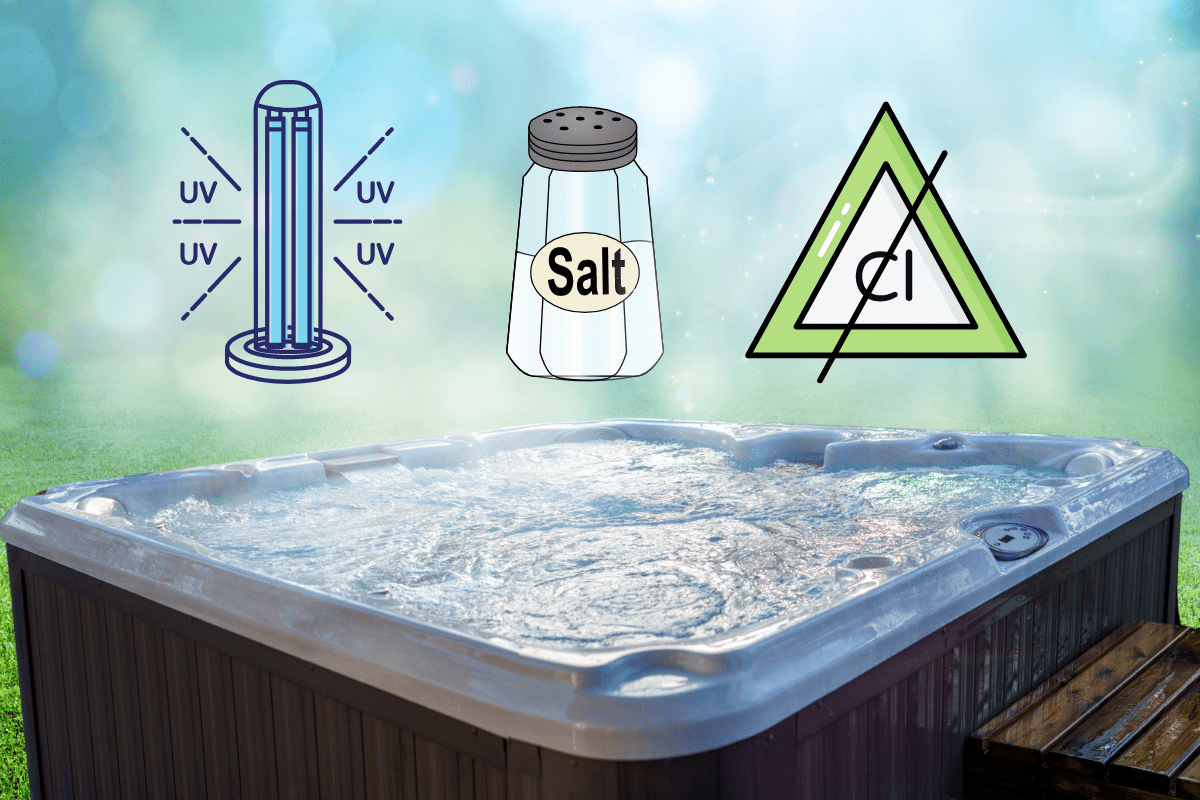
**2\. Salt Systems:** Salt electrolysis **produces chlorine**, eliminating the need for typical chlorine or bromine products. However, this procedure still generates chlorine, thus it does not ensure a chlorine-free hot tub.

**3\. Ultraviolet (UV) System:** Radiation is used to **sanitize water**, decreasing the need for chlorine or other chemicals. Whether you have inflatable or traditional hot tubs, you can utilize a UV system to replace and perform the function of chlorine. It keeps your hot tub water clean by emitting UV radiation as it passes through the UV bulbs.

**4\. Mineral-Based Systems:** Reduce the need for chlorine or other sanitizers by using minerals like silver or copper to inhibit bacterial growth.

**5\. Ionizers:** Release ions into the water to **prevent algae and bacteria growth,** decreasing the need for sanitizer. While they are a natural treatment but not completely sanitised and may need to be combined with sanitiser.

**6\. Ozonators:** Inject ozone into the hot tub water to **reduce sanitizer usage** and the need for repeated shocking. While they aren’t registered sanitizers, they are a chemical-free way to keep your water clean.

**7\. Enzyme-Based Treatment:** Breaking down organic pollutants using natural enzymes to maintain hot tub water. While not a substitute for shock and sanitizer, it reduces the need for other chemicals to provide clean water.

**8\. Biguanide:** Polyhexamethylene biguanide **(PHMB) is a gentle, chlorine-free, and bromine-free sanitizer option** for hot tub maintenance. However, users should be vigilant about potential water quality issues. It’s important to note that PHMB does not mix with chlorine, so if you decide to switch back to chlorine or bromine, proper cleaning steps will be necessary.

**9\. Scale Inhibitors:** These are substances added to hot tub water to **prevent the accumulation of scale,** which is caused by minerals like calcium and magnesium. By using them, you can enhance the effectiveness of sanitizers and reduce the need for additional chemicals to maintain water cleanliness.

**10\. pH Balancers:** These chemicals are added to **adjust the acidity or alkalinity of the water** to the desired level, helping to maintain proper pH balance. This enhances the effectiveness of sanitizers and reduces the need for additional chemicals to keep the water clean.

**Note:** Always consult a professional or review the manufacturer’s instructions for compatibility and safety precautions before opting for any alternative hot tub chemicals.

Also, check out the [Causes, Effects and Solutions of Groundwater Depletion](https://energytheory.com/effects-of-groundwater-depletion/)

### **Pros and Cons of Hot Tub Chemical Alternatives**

![natural alternatives to hot tub chemicals 1](https://energytheory.com/wp-content/uploads/2024/02/natural-alternatives-to-hot-tub-chemicals-1.jpg)

Before opting for natural alternatives to hot tub chemicals, it’s crucial to explore and understand the advantages and disadvantages of each option:

| **Alternative**            | **Pros**                                                               | **Cons**                                                                                    |
| -------------------------- | ---------------------------------------------------------------------- | ------------------------------------------------------------------------------------------- |
| **Non-Chlorine Shock**     | Removes contaminants and reduces chlorine usage                        | May not fully sanitize and could lead to residual chlorine.                                 |
| **Salt Systems**           | Eliminates the need for traditional chlorine or bromine                | Can produce chlorine through salt electrolysis.                                             |
| **Ultraviolet System**     | Sanitizes water and lowers the need for chemicals                      | May still require some sanitizer for complete cleanliness                                   |
| **Mineral-Based System**   | Reduces the need for sanitizers, suppresses bacterial growth           | May not be sufficient as a standalone sanitizer                                             |
| **Ionizers**               | Reduces the need for sanitizer and prevents algae and bacteria growth. | May not be sufficient as a standalone sanitizer.                                            |
| **Ozonators**              | Reduces the need for sanitizer and the frequency of shocking.          | Not a registered sanitizer, still requires some usage of sanitizer                          |
| **Enzyme-Based Treatment** | Reduces chemical usage in water maintenance                            | May not be sufficient as a standalone sanitizer                                             |
| **Biguanide**              | Offers a gentle alternative to chlorine or bromine.                    | Requires non-bromine and non-chlorine shock treatments, otherwise may lead to water issues. |
| **Scale Inhibitors**       | Prevents scale buildup and enhances sanitizer efficacy.                | May not be adequate as a standalone sanitizer.                                              |
| **pH Balancers**           | Maintains optimal pH and boosts sanitizer effectiveness.               | May not be adequate as a standalone sanitizer.                                              |

**Also See:** [30 Practical Ways to Reduce Water Pollution](https://energytheory.com/ways-to-reduce-water-pollution/)

### **Tips to Maintain Hot Tub without Chemicals**

![Hot Tub Chemical Alternatives](https://energytheory.com/wp-content/uploads/2024/02/Hot-Tub-Chemical-Alternatives.jpg)

Hot tubs provide relaxation and rejuvenation, but keeping them clean without using chemicals needs careful upkeep. Here are some crucial tips for keeping a chemical-free hot tub in good condition:

**Tip-1 Cover Your Hot Tub:** A durable hot tub cover, such as a thermal blanket, functions as a barrier, keeping debris and impurities out of the water. Minimizing exposure to external elements reduces the need for chemical treatments to keep the water clean.

**Tip-2 Rinse off before Entering:** Encourage everyone to shower before entering the hot tub to eliminate dirt, oils, and other impurities. This easy procedure helps to limit water contamination.

**Tip-3 Regularly Drain and Refill:** Follow this practice for the hot tub **every 3 to 4 months** for chlorine-based tubs, or more frequently (every 2 to 3 months) for non-chlorinated ones, to eliminate accumulated contaminants. This ensures that the water remains fresh and clean, reducing the need for chemical additives.

**Tip-4 Clean Components:** Regularly cleaning the filter cartridge and [removing biofilm accumulation](https://www.ncbi.nlm.nih.gov/pmc/articles/PMC5886460/) is critical for water quality, filter efficacy, and safety. This procedure involves utilizing a bleach and hot water solution, then rinsing and allowing it to dry for one day before reinstalling it.

**Tip-5 Optimize Pump Operation:** Proper circulation is essential for reducing stagnant water and bacteria growth. Running the hot tub pump for **at least 8 hours each day,** or according to the manufacturer’s guidelines, helps distribute water evenly and reduces the need for chemical additions to preserve water quality.

**Tip-6 Pre-Treat Water:** Before adding water to the hot tub, **test it for pH,** alkalinity, and calcium levels. Adjust any imbalances using appropriate treatments to ensure that the water is free from microorganisms and chemical contaminants, reducing the reliance on chemical sanitizers.

By following these simple procedures, you can effectively operate a chemical-free hot tub and enjoy clean, safe water for relaxation and enjoyment.

Ultimately, these natural alternatives to hot tub chemicals include salt, UV, and mineral-based systems that offer both benefits and drawbacks. However, their adoption necessitates meticulous monitoring of water parameters like temperature, hardness, and pH levels to ensure health safety, environmental sustainability, and cost-effectiveness. For more insightful content, keep reading our blogs.

**Recommended:** [15 Most Common Water Wastage Causes and their Effects](https://energytheory.com/water-wastage-causes/)

Share. [ Facebook ](https://www.facebook.com/sharer.php?u=https%3A%2F%2Fenergytheory.com%2Fnatural-alternatives-to-hot-tub-chemicals%2F "Share on Facebook") [ Twitter ](https://twitter.com/intent/tweet?url=https%3A%2F%2Fenergytheory.com%2Fnatural-alternatives-to-hot-tub-chemicals%2F&text=10%20Natural%20Alternatives%20to%20Hot%20Tub%20Chemicals "Share on X (Twitter)") [ Pinterest ](https://pinterest.com/pin/create/button/?url=https%3A%2F%2Fenergytheory.com%2Fnatural-alternatives-to-hot-tub-chemicals%2F&media=https%3A%2F%2Fenergytheory.com%2Fwp-content%2Fuploads%2F2024%2F02%2Fnatural-alternatives-to-hot-tub-chemicals.webp&description=10%20Natural%20Alternatives%20to%20Hot%20Tub%20Chemicals "Share on Pinterest") [ LinkedIn ](https://www.linkedin.com/shareArticle?mini=true&url=https%3A%2F%2Fenergytheory.com%2Fnatural-alternatives-to-hot-tub-chemicals%2F "Share on LinkedIn") [ Tumblr ](https://www.tumblr.com/share/link?url=https%3A%2F%2Fenergytheory.com%2Fnatural-alternatives-to-hot-tub-chemicals%2F&name=10%20Natural%20Alternatives%20to%20Hot%20Tub%20Chemicals "Share on Tumblr") [ Telegram ](https://t.me/share/url?url=https%3A%2F%2Fenergytheory.com%2Fnatural-alternatives-to-hot-tub-chemicals%2F&title=10%20Natural%20Alternatives%20to%20Hot%20Tub%20Chemicals "Share on Telegram") [ Email ](mailto:?subject=10%20Natural%20Alternatives%20to%20Hot%20Tub%20Chemicals&body=https%3A%2F%2Fenergytheory.com%2Fnatural-alternatives-to-hot-tub-chemicals%2F "Share via Email") 

![mm](https://energytheory.com/wp-content/uploads/2023/04/Olivia-150x150.jpg) 

[Olivia Bolt](https://energytheory.com/author/olivia%5Fbolt/) 

Olivia is committed to green energy and works to help ensure our planet's long-term habitability. She takes part in environmental conservation by recycling and avoiding single-use plastic.

#### Related Posts

[![What is green energy](https://energytheory.com/wp-content/uploads/2024/09/What-is-green-energy-300x200.webp "What is Green Energy: Definition, Importance, and Examples")](https://energytheory.com/what-is-green-energy-definition-importance-and-examples/ "What is Green Energy: Definition, Importance, and Examples") 

#### [What is Green Energy: Definition, Importance, and Examples](https://energytheory.com/what-is-green-energy-definition-importance-and-examples/)

September 13, 2024

[![ways to save water for kids](https://energytheory.com/wp-content/uploads/2024/05/ways-kids-can-save-water-300x200.png "Ways to Save Water for Kids: 10+ Easy Methods")](https://energytheory.com/ways-to-save-water-for-kids-10-easy-methods/ "Ways to Save Water for Kids: 10+ Easy Methods") 

#### [Ways to Save Water for Kids: 10+ Easy Methods](https://energytheory.com/ways-to-save-water-for-kids-10-easy-methods/)

May 28, 2024

[![](https://energytheory.com/wp-content/uploads/2024/05/Wangari-Maathai-300x200.png "Wangari’s Trees of Peace: Girl Got Noble Prize for Planting Trees")](https://energytheory.com/wangaris-trees-of-peace-girl-got-noble-prize-for-planting-trees/ "Wangari’s Trees of Peace: Girl Got Noble Prize for Planting Trees") 

#### [Wangari’s Trees of Peace: Girl Got Noble Prize for Planting Trees](https://energytheory.com/wangaris-trees-of-peace-girl-got-noble-prize-for-planting-trees/)

May 25, 2024

[Add A Comment ](#) 

Leave A Reply [Cancel Reply](https://energytheory.com/natural-alternatives-to-hot-tub-chemicals/#respond)

Save my name, email, and website in this browser for the next time I comment. 

Submit 

Type above and press _Enter_ to search. Press _Esc_ to cancel.

```json
{"@context":"https:\/\/schema.org","@graph":[{"@type":"Article","@id":"https:\/\/energytheory.com\/natural-alternatives-to-hot-tub-chemicals\/#article","isPartOf":{"@id":"https:\/\/energytheory.com\/natural-alternatives-to-hot-tub-chemicals\/"},"author":{"name":"Olivia Bolt","@id":"https:\/\/energytheory.com\/#\/schema\/person\/b13704b48c0839ab40218296652c13b8"},"headline":"10 Natural Alternatives to Hot Tub Chemicals","datePublished":"2024-02-22T16:54:30+00:00","dateModified":"2024-02-22T17:01:55+00:00","mainEntityOfPage":{"@id":"https:\/\/energytheory.com\/natural-alternatives-to-hot-tub-chemicals\/"},"wordCount":1134,"commentCount":0,"publisher":{"@id":"https:\/\/energytheory.com\/#organization"},"image":{"@id":"https:\/\/energytheory.com\/natural-alternatives-to-hot-tub-chemicals\/#primaryimage"},"thumbnailUrl":"https:\/\/energytheory.com\/wp-content\/uploads\/2024\/02\/natural-alternatives-to-hot-tub-chemicals.webp","keywords":["Hot Tub Chemical Alternatives","natural alternatives to hot tub chemicals","Pros and Cons of Hot Tub Chemical Alternatives"],"articleSection":["Green","Tips &amp; Tricks"],"inLanguage":"en-US","potentialAction":[{"@type":"CommentAction","name":"Comment","target":["https:\/\/energytheory.com\/natural-alternatives-to-hot-tub-chemicals\/#respond"]}]},{"@type":"WebPage","@id":"https:\/\/energytheory.com\/natural-alternatives-to-hot-tub-chemicals\/","url":"https:\/\/energytheory.com\/natural-alternatives-to-hot-tub-chemicals\/","name":"10 Natural Alternatives to Hot Tub Chemicals - Energy Theory","isPartOf":{"@id":"https:\/\/energytheory.com\/#website"},"primaryImageOfPage":{"@id":"https:\/\/energytheory.com\/natural-alternatives-to-hot-tub-chemicals\/#primaryimage"},"image":{"@id":"https:\/\/energytheory.com\/natural-alternatives-to-hot-tub-chemicals\/#primaryimage"},"thumbnailUrl":"https:\/\/energytheory.com\/wp-content\/uploads\/2024\/02\/natural-alternatives-to-hot-tub-chemicals.webp","datePublished":"2024-02-22T16:54:30+00:00","dateModified":"2024-02-22T17:01:55+00:00","description":"The natural alternatives to hot tub chemicals include non-chlorine shock, salt systems, Ultraviolet system, ionizers, and pH balancers.","breadcrumb":{"@id":"https:\/\/energytheory.com\/natural-alternatives-to-hot-tub-chemicals\/#breadcrumb"},"inLanguage":"en-US","potentialAction":[{"@type":"ReadAction","target":["https:\/\/energytheory.com\/natural-alternatives-to-hot-tub-chemicals\/"]}]},{"@type":"ImageObject","inLanguage":"en-US","@id":"https:\/\/energytheory.com\/natural-alternatives-to-hot-tub-chemicals\/#primaryimage","url":"https:\/\/energytheory.com\/wp-content\/uploads\/2024\/02\/natural-alternatives-to-hot-tub-chemicals.webp","contentUrl":"https:\/\/energytheory.com\/wp-content\/uploads\/2024\/02\/natural-alternatives-to-hot-tub-chemicals.webp","width":1200,"height":800,"caption":"natural alternatives to hot tub chemicals"},{"@type":"BreadcrumbList","@id":"https:\/\/energytheory.com\/natural-alternatives-to-hot-tub-chemicals\/#breadcrumb","itemListElement":[{"@type":"ListItem","position":1,"name":"Home","item":"https:\/\/energytheory.com\/"},{"@type":"ListItem","position":2,"name":"Green","item":"https:\/\/energytheory.com\/category\/green\/"},{"@type":"ListItem","position":3,"name":"10 Natural Alternatives to Hot Tub Chemicals"}]},{"@type":"WebSite","@id":"https:\/\/energytheory.com\/#website","url":"https:\/\/energytheory.com\/","name":"Energy Theory","description":"Conserve energy to preserve future","publisher":{"@id":"https:\/\/energytheory.com\/#organization"},"potentialAction":[{"@type":"SearchAction","target":{"@type":"EntryPoint","urlTemplate":"https:\/\/energytheory.com\/?s={search_term_string}"},"query-input":{"@type":"PropertyValueSpecification","valueRequired":true,"valueName":"search_term_string"}}],"inLanguage":"en-US"},{"@type":"Organization","@id":"https:\/\/energytheory.com\/#organization","name":"Energy Theory","url":"https:\/\/energytheory.com\/","logo":{"@type":"ImageObject","inLanguage":"en-US","@id":"https:\/\/energytheory.com\/#\/schema\/logo\/image\/","url":"https:\/\/energytheory.com\/wp-content\/uploads\/2022\/11\/2e3rtgthghnm.png","contentUrl":"https:\/\/energytheory.com\/wp-content\/uploads\/2022\/11\/2e3rtgthghnm.png","width":625,"height":57,"caption":"Energy Theory"},"image":{"@id":"https:\/\/energytheory.com\/#\/schema\/logo\/image\/"},"sameAs":["https:\/\/www.facebook.com\/energytheoryco"]},{"@type":"Person","@id":"https:\/\/energytheory.com\/#\/schema\/person\/b13704b48c0839ab40218296652c13b8","name":"Olivia Bolt","image":{"@type":"ImageObject","inLanguage":"en-US","@id":"https:\/\/secure.gravatar.com\/avatar\/e44b6048cc46ab5ff090bb0f7eab60cc3364aba06f873623f727e8a9215b302a?s=96&d=mm&r=g","url":"https:\/\/secure.gravatar.com\/avatar\/e44b6048cc46ab5ff090bb0f7eab60cc3364aba06f873623f727e8a9215b302a?s=96&d=mm&r=g","contentUrl":"https:\/\/secure.gravatar.com\/avatar\/e44b6048cc46ab5ff090bb0f7eab60cc3364aba06f873623f727e8a9215b302a?s=96&d=mm&r=g","caption":"Olivia Bolt"},"description":"Olivia is committed to green energy and works to help ensure our planet's long-term habitability. She takes part in environmental conservation by recycling and avoiding single-use plastic.","url":"https:\/\/energytheory.com\/author\/olivia_bolt\/"}]}
```